
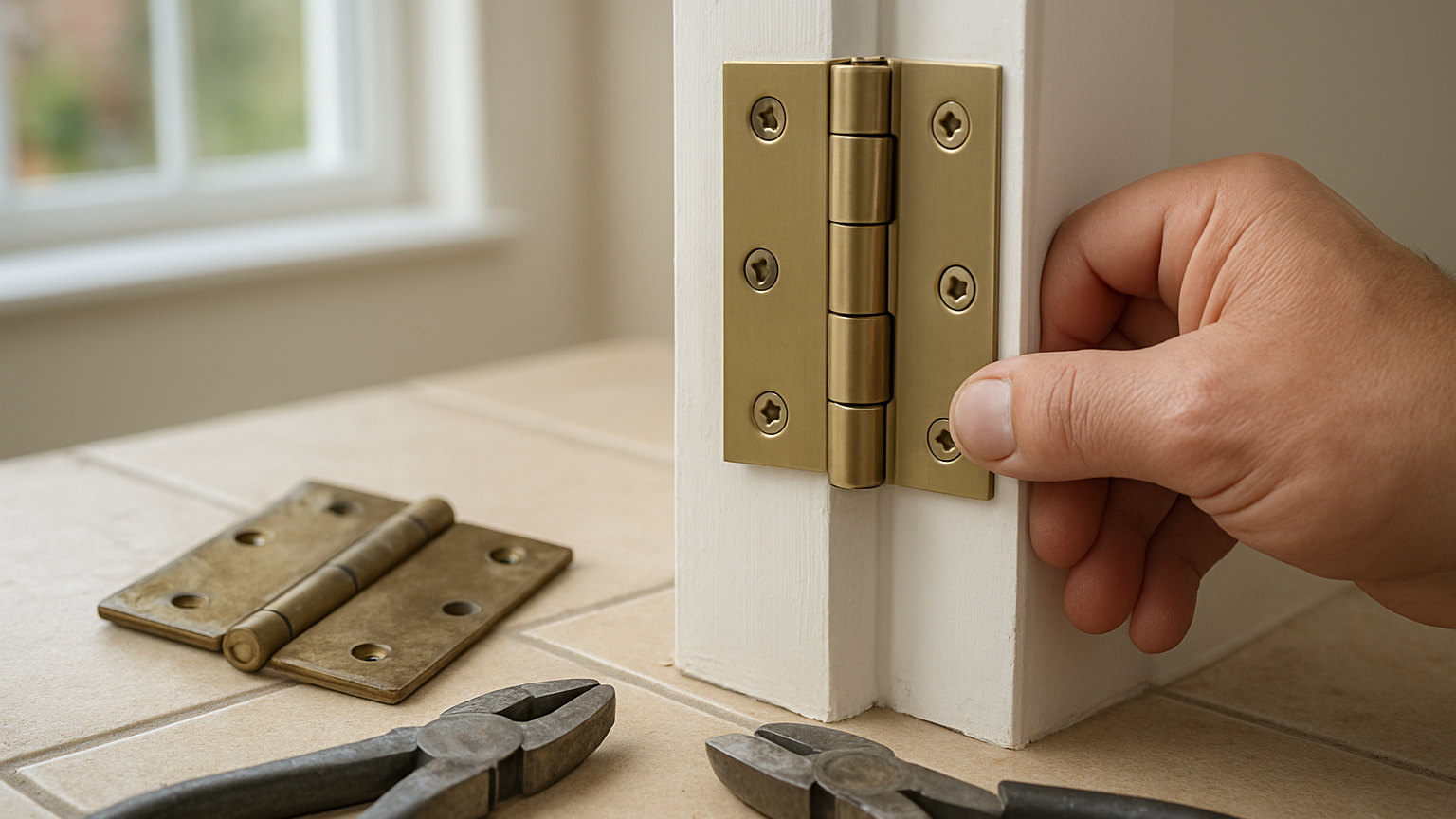
Hinges carry the whole weight of a door and take every opening and closing. When a door drops, binds, springs open or will not latch, the hinges are the first place to look.
What you need
- Screwdrivers matching the hinge screws
- Replacement hinges, if needed
- A sharp chisel, 25mm, and a mallet
- A marking knife or a sharp pencil
- Card, thin plywood or hardboard for packing
- Wood glue, dowels or matchsticks
- Longer screws, 60mm or more
- A bradawl and a drill with small bits
- Wedges, and help lifting
Step 1: diagnose from the symptom
- Door dropped, binding at the top of the latch side: loose screws, or the top hinge pulling out
- Door binds on the hinge side: the recess is too shallow, or paint has built up
- Door will not close fully, springs back: the recess is too deep, or a screw head is proud
- Door swings open or closed on its own: the hinges are not plumb, or the frame is out of level
- Squeaking: lubrication
- Grinding, stiff movement: a worn or distorted hinge
Step 2: the free fixes
- Tighten every screw in every hinge
- Check for screws standing proud and drive them fully home, or countersink deeper
- Strip built-up paint from the hinge leaves and the recesses
- Check the hinge knuckles are not bent or distorted
This alone resolves a great many door problems.
Step 3: worn screw holes
A screw that spins is not holding anything.
Option 1, longer screws. Replace one screw per hinge with a 60mm or 75mm screw that passes through the frame into the structural timber behind. The quickest and most effective repair for a dropped door. Countersink it fully.
Option 2, plug the hole.
- Remove the screw
- Squeeze wood glue into the hole
- Tap in hardwood dowels, matchsticks or a glued golf tee until packed solid
- Trim flush and let it set fully
- Drill a fresh pilot hole and refit
Do not simply fit a fatter screw, which splits the timber.
Step 4: packing a hinge
Where the door binds on the hinge side, the recess is too deep or the door sits too close.
- Loosen the screws of the hinge concerned
- Cut a piece of thin card or hardboard to the shape of the hinge leaf
- Slide it behind the leaf, into the recess
- Retighten and test
- Add or remove packing until the door closes cleanly
Packing the top hinge only moves the bottom of the latch edge across; packing the bottom hinge only moves the top. Use this to correct a door binding at one corner.
Step 5: deepening a recess
Where the door binds on the latch side and the hinge leaf stands proud.
- Remove the hinge
- Score the outline of the recess with a marking knife
- Make a series of shallow chisel cuts across the recess, bevel down, to the required depth
- Pare the waste out with the chisel held flat, bevel up
- Check the hinge leaf sits exactly flush with the surface
- Refit and test
Take very little at a time. A recess cut too deep needs packing to correct.
Step 6: replacing a hinge
- Wedge the door firmly so it cannot move or fall
- Remove the screws from the frame side of the hinge being replaced, leaving the others in place
- Take the old hinge to match: measure the leaf height, width and knuckle
- Fit the new hinge into the existing recess
- Where the new hinge is a slightly different size, adjust the recess with a chisel or fill and recut
- Drill pilot holes for every screw
- Fit the screws, driving them fully home and square
Replace hinges in pairs or sets so the door hangs evenly.
Step 7: how many hinges
- Two hinges: a light internal door, hollow core
- Three hinges: a solid internal door, any external door, a heavy or tall door, and any fire door
- The third goes in the middle, or slightly above centre
A solid door on two hinges will drop. Adding a third is a straightforward improvement.
Step 8: hinge types
- Butt hinge: the standard door hinge, in steel or brass
- Ball bearing butt hinge: smoother and longer lasting on heavy doors. Worth fitting to a solid or external door
- Rising butt hinge: lifts the door as it opens, clearing a carpet, and it closes itself. Handed, so specify left or right
- Fire door hinges: must be CE or UKCA marked and suitable for fire doors, usually three per door
- Concealed hinges: mainly on cabinets
Standard sizes
- 75mm: light internal doors
- 100mm: the standard for internal and external doors
- Match the existing size where replacing, or the recesses need recutting
Lubrication
- A drop of light machine oil or a silicone spray on each knuckle
- Work the door back and forth to distribute it
- Wipe the excess before it collects dust
- Avoid heavy greases, which attract dirt
If it goes wrong
Door still drops: fit a long screw into the structure behind the frame, and consider a third hinge.
Recess cut too deep: pack behind the leaf with card.
Screws will not go in square: drill accurate pilot holes first.
New hinge does not fit the recess: match the old one exactly, or recut the recess.
Door swings open on its own: the frame is out of plumb. Packing one hinge can compensate slightly.
Taking a door off and rehanging it
- Open the door and wedge it firmly under the latch edge
- Get help: an internal door is heavier than it looks and an external one considerably more
- Remove the screws from the lower hinge first, then the middle, then the top
- Lift the door away and lay it flat, protecting the face underneath
- Rehang in reverse: top hinge first, with one screw only, then check the alignment before fitting the rest
- Number the hinges and bag the screws separately


