
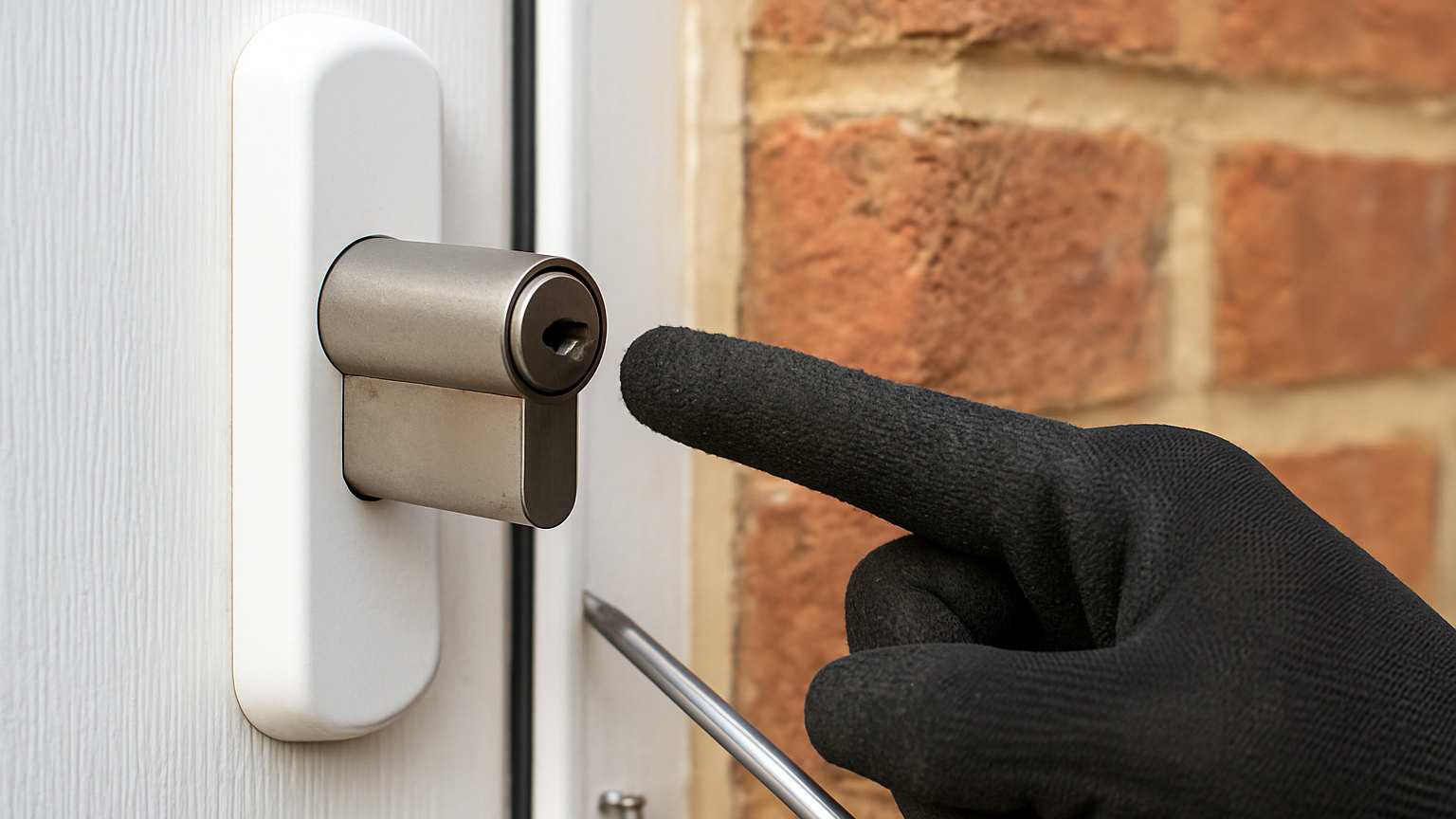
Changing a euro cylinder is one of the easiest security improvements available: one screw, five minutes, and no specialist tools. Getting the size right is the only real requirement.
Why it matters
Lock snapping is a known method of attack on uPVC and composite doors. The cylinder is gripped and snapped at its weakest point, then the mechanism operated directly.
Two things defeat it:
- A cylinder rated TS 007 3-star, or 1-star used with 2-star security handles, or a Sold Secure Diamond cylinder
- Correct sizing, so the cylinder does not protrude and cannot be gripped
A cylinder standing more than about 3mm proud of the handle is a vulnerability. Look at yours now: if it sticks out, it needs replacing with the correct size.
Step 1: measure it
Euro cylinders are measured from the centre of the fixing screw hole outward, in two halves.
- Open the door and look at the edge, where a single screw passes through the faceplate into the cylinder
- Measure from the centre of that screw hole to the outside face of the door. That is the external measurement
- Measure from the centre of the screw hole to the inside face. That is the internal measurement
- Measure to the face of the door, or to the face of the handle plate if the cylinder should sit flush with it
- Write it as external / internal, for example 40/50
The two halves are frequently different lengths, and the order matters. A 40/50 cylinder is not the same as a 50/40.
Common sizes are in 5mm steps: 30, 35, 40, 45, 50 and so on. Overall lengths of 70mm, 80mm and 90mm are typical.
Step 2: the easier method
If in any doubt, remove the old cylinder first and measure it directly on the bench.
You cannot get the measurement wrong that way, and the door can be left latched shut while you go to buy the replacement.
What you need
- The new cylinder, correctly sized and rated
- A long thin screwdriver, usually a cross-head
- The key for the existing lock
- A tape measure or a ruler
- A little dry lubricant
Step 3: remove the old cylinder
- Open the door and keep it open
- Find the single long screw in the door edge faceplate, level with the centre of the cylinder
- Undo it completely and put it somewhere safe. It is usually 60 to 90mm long
- Insert the key into the cylinder
- Turn the key a small amount, roughly 10 to 15 degrees, either way, until you feel the cam align with the body
- Pull the cylinder out sideways by the key
The cam, the small tongue that operates the mechanism, protrudes below the body and will not pass through the door until it is aligned. That turn of the key is the whole trick.
If it will not come out, turn the key slightly the other way and try again. Do not force it.
Step 4: fit the new one
- Put the key into the new cylinder and turn it to the same small angle, so the cam is aligned
- Check which way round it goes: the longer half almost always goes to the inside, and the keyway or thumbturn faces the correct way
- Slide it into the door until the screw hole lines up
- Look through the faceplate hole to check the alignment
- Fit the fixing screw and tighten it firmly, without overtightening
- Remove the key and test
Do not overtighten the screw, which can bind the cylinder and make the key stiff.
Step 5: test thoroughly
- Test the key from both sides with the door open first
- Lift the handle and lock it, then unlock it, several times
- Check the key withdraws freely in the locked and unlocked positions
- Only then close the door and test again
- Check the door still locks and unlocks smoothly when closed
Never test a new lock for the first time with the door closed.
Step 6: choosing the replacement
- TS 007 3-star, or 1-star cylinder with 2-star handles, or Sold Secure Diamond
- Look for anti-snap, anti-bump, anti-drill and anti-pick features
- Correct size, so it sits flush or protrudes no more than about 3mm
- Decide between key both sides and key with thumbturn
- Consider having several doors keyed alike, so one key operates all of them
- Buy from a reputable source; unbranded cylinders claiming ratings are worth avoiding
Thumbturn or key both sides
A genuine trade-off.
- Thumbturn: faster escape in a fire, no hunting for a key. Not suitable where there is glazing or a letterbox within reach of it, since it can be reached and turned
- Key both sides: more secure against reaching through, and an escape risk if the key is not immediately to hand
Where a key is needed to get out, keep one in a fixed place near the door, out of sight and out of reach of the letterbox, known to everyone in the house.
Maintenance
- Lubricate with a dry PTFE or graphite lubricant once or twice a year
- Never use oil or a general purpose spray in a lock: it attracts dust, gums up and eventually seizes the mechanism
- Do not force a stiff key; find out why it is stiff
- Replace a worn key before it snaps in the lock
If it goes wrong
Cylinder will not come out: the cam is not aligned. Turn the key a few degrees each way.
New cylinder too long or short: measure from the centre of the screw hole to each face, and note which half is which.
Key stiff after fitting: the fixing screw is overtightened, or the cylinder is not seated. Loosen and reseat.
Handle will not lift: the cylinder is in the wrong way round, or the cam is fouling.
Cylinder still protrudes: the size is wrong. Measure again and get the right one.
A summary
- Measure from the centre of the fixing screw hole to each face, and note which half is which
- Or remove the old one and measure it directly
- Undo the single long screw in the door edge
- Turn the key 10 to 15 degrees to align the cam, then withdraw
- Fit a 3-star or Sold Secure Diamond cylinder, sized to sit flush
- Test from both sides with the door open before closing it


