
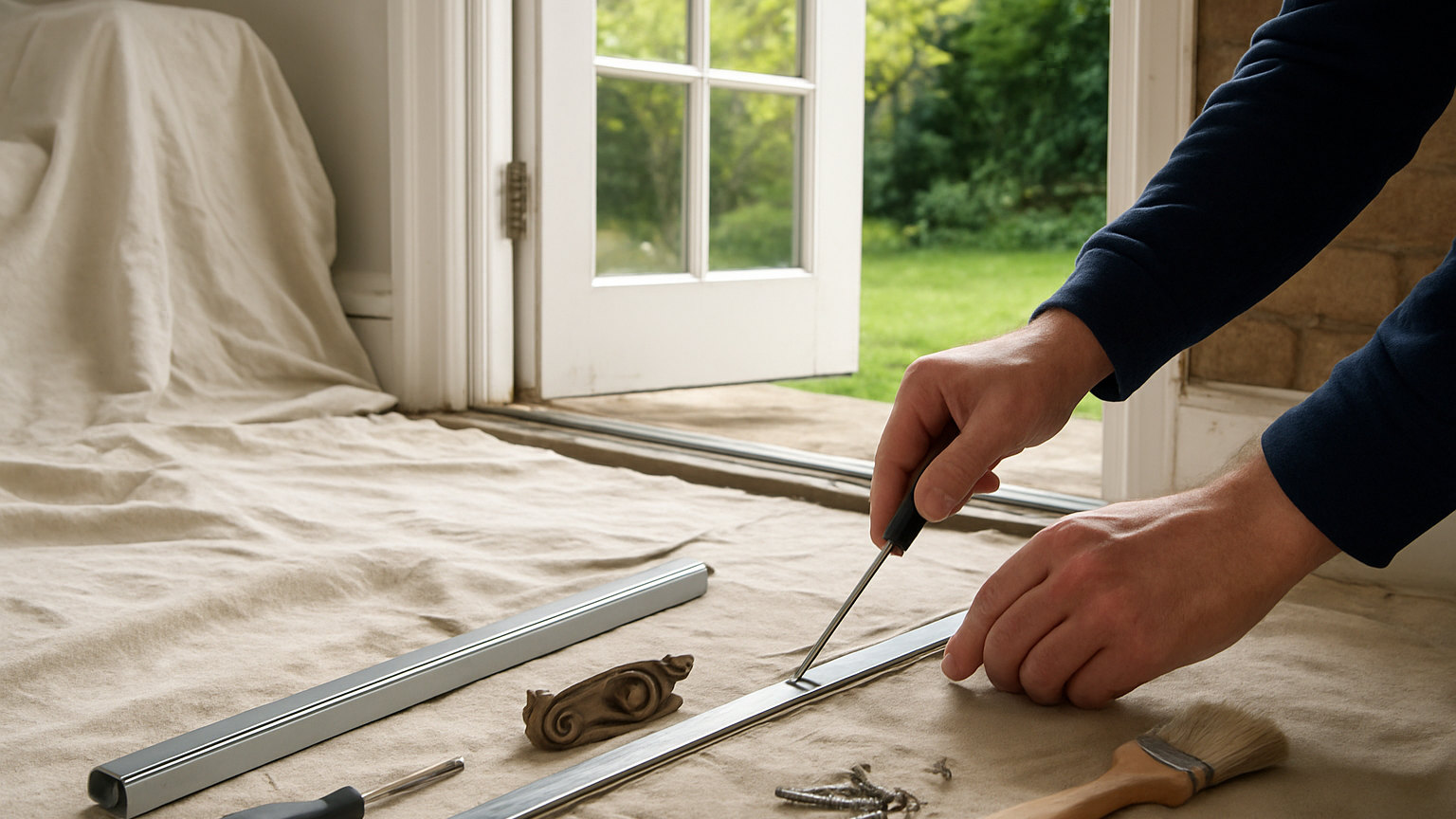
Patio and french doors are large, heavy and get used constantly. Nearly all their problems come down to dirt, worn rollers or alignment.
Sliding patio doors
Step 1: clean the track
Do this before anything else. It solves a surprising proportion of sliding door problems.
- Vacuum the full length of the bottom track, using a crevice tool
- Scrub the track with a stiff brush and hot soapy water
- Use an old toothbrush and a screwdriver wrapped in cloth to clear the corners of the channel
- Rinse and dry thoroughly
- Check the track is not bent, dented or worn anywhere along its length
- Clean the top guide channel as well
Grit in the track wears the rollers and the track itself, so keeping it clean is the main preventative measure.
Step 2: lubricate
- Apply a dry silicone or PTFE lubricant to the track
- Do not use oil or grease, which collects grit and forms an abrasive paste
- Work the door back and forth to distribute it
- Wipe any excess
Step 3: adjust the rollers
Sliding doors run on rollers at the bottom, adjustable for height.
- Look at the bottom of the door edge for small adjustment screws, frequently behind plastic caps or plugs
- There is usually one near each end
- Prise the cap off and note the starting position
- Turning clockwise usually raises the door; anticlockwise lowers it
- Adjust a quarter turn at a time, alternating between the two ends
- Test the slide and the seal after each adjustment
- Aim for the door to slide freely, sit level, and seal evenly against the frame
Raising the door slightly is the usual fix for a door that drags. If it is already at maximum, the rollers are worn.
Step 4: worn rollers
Signs: the door drags even at full adjustment, it grinds, or it feels notchy.
- Roller replacement means lifting the door out of the frame, which is heavy work
- A patio door leaf is very heavy and awkward. Get help, or get a specialist in
- Take the old roller to match the replacement, since there are many patterns
- Replace both rollers at once
- Have the track repaired or capped if it is worn
Step 5: the lock and handle
- Sliding doors usually have a hook bolt engaging a keep in the frame
- Where it will not engage, the door height is wrong or the keep needs adjusting
- Most keeps have slotted holes for adjustment
- Fit an additional patio door lock or bolt for security, since sliding doors can be vulnerable
- Anti-lift blocks in the top channel prevent the door being lifted out of its track
French doors
Two hinged leaves, usually with one master leaf carrying the handle and lock, and a slave leaf held by shoot bolts.
Step 6: diagnose french door problems
- Doors do not meet in the middle: one or both leaves have dropped
- Handle will not lift: misalignment, or the slave leaf is not properly bolted
- Draughty in the middle: compression, or a perished seal
- Slave leaf rattles: the shoot bolts are not engaging fully
- One leaf catches at the top: that leaf has dropped
Step 7: adjust the hinges
uPVC and composite french doors have adjustable hinges, the same as a single door.
- Remove the hinge caps
- Note the starting positions
- Adjust height first to bring the leaf back up
- Then lateral to set the gap between the leaves
- Then compression to set the seal
- A quarter turn at a time, testing after each
- Support the leaf while adjusting
Timber french doors adjust with hinge packing and long screws, as with any timber door.
Step 8: the shoot bolts
The bolts at the top and bottom of the slave leaf.
- Open both leaves and operate the slave leaf handle or lever
- Check both bolts throw fully and smoothly
- Mark the bolt ends and close the leaf to see where they strike
- Adjust the keeps in the frame head and the threshold, which usually have slotted holes
- Some shoot bolts have an adjustable end, screwing in or out to alter their throw
- Clear any debris from the floor socket, which fills with grit
- Lubricate with a dry lubricant
The slave leaf must be fully bolted before the master leaf will lock properly. Many french door lock problems are simply that.
Step 9: seals
- Inspect the rubber gaskets around each leaf and where they meet
- Perished, flattened or shrunken seals cause draughts and leaks
- Replacement gaskets are available by profile, and pull out and push in
- Take a short offcut to match the profile
- Clean the seals with soapy water and treat with a silicone product to keep them supple
Water ingress
- Check the drainage slots in the bottom of the frame are clear. They fill with grit and dead insects
- Clear them with a thin wire or a vacuum
- Check the threshold drains outward
- Check the external sealant around the frame
- Never seal the drainage slots
If it goes wrong
Sliding door still drags at full adjustment: the rollers or the track are worn.
Leaves will not meet: adjust height then lateral, one leaf at a time.
Handle will not lift: check the slave leaf is fully bolted first.
Water coming in at the threshold: blocked drainage slots.
Door too heavy to lift out: get help or a specialist. A patio door leaf is a two-person lift at minimum.
A summary
- Clean the track thoroughly before adjusting anything
- Use a dry lubricant, never oil or grease, which collects grit
- Adjust sliding door rollers a quarter turn at a time, alternating ends
- Adjust french door hinges in the order height, lateral, compression
- The slave leaf must be fully bolted before the master will lock
- Keep the frame drainage slots clear


