
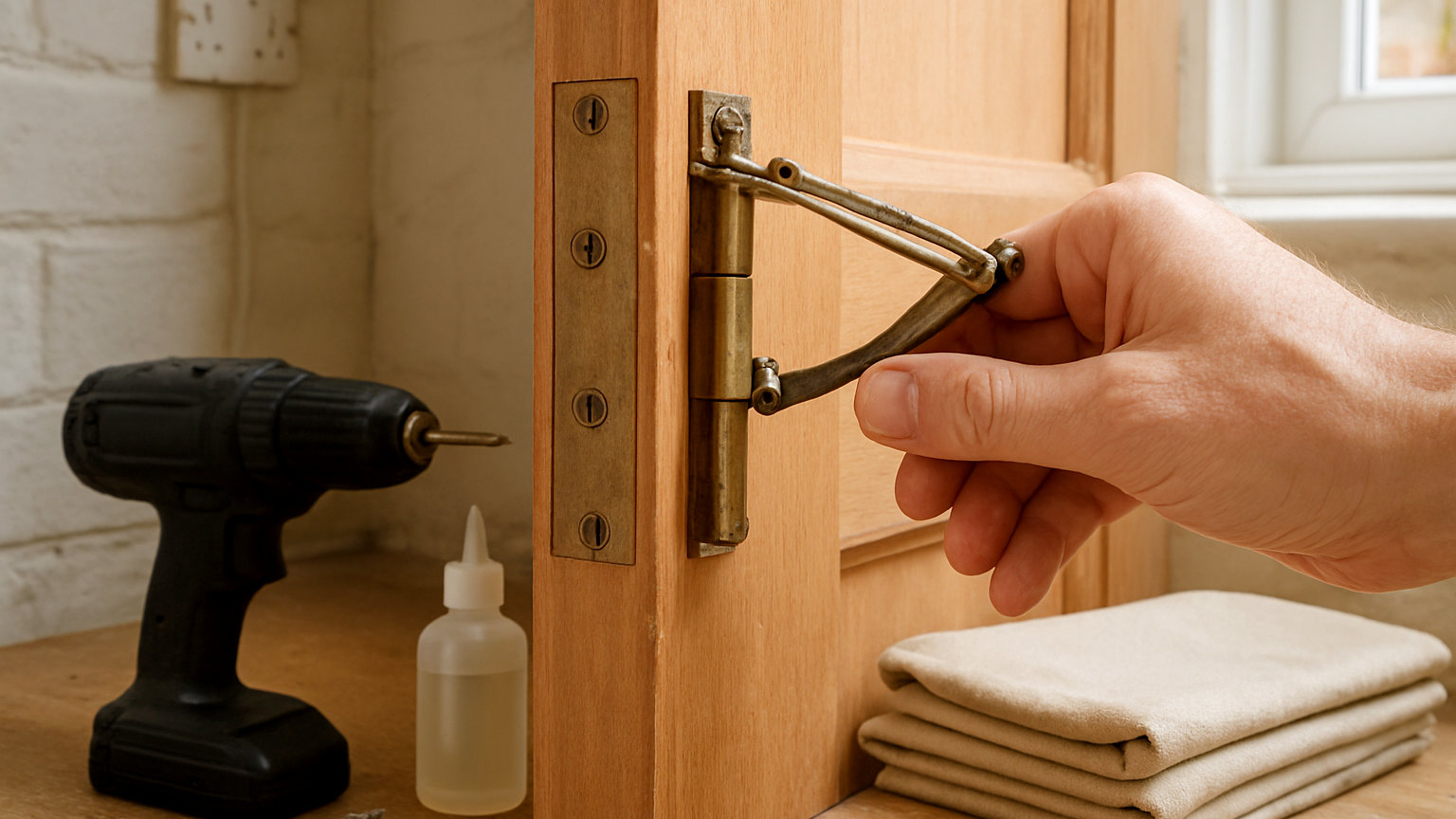
Two of the most irritating household noises, and both are usually a five-minute job.
Squeaking hinges
The noise is metal rubbing on metal in a dry hinge knuckle, sometimes with rust or grit.
What you need
- Light machine oil, or a silicone or PTFE spray
- A cloth and some kitchen roll
- A nail punch or a thin nail, and a hammer
- Wire wool or an abrasive pad
- A screwdriver
Quick fix: lubricate in place
- Apply two or three drops of light machine oil to the top of each hinge knuckle, where the pin enters
- Work the door back and forth ten or fifteen times to draw the oil down
- Apply a little more if needed
- Wipe all the excess off immediately, since oil runs down the frame and collects dust
- Put kitchen roll below the hinge while you work
Which lubricant
- Light machine oil: effective and long lasting. The usual choice
- Silicone spray: clean, does not attract dust, good on painted hinges
- PTFE dry lubricant: the cleanest option, leaves no residue
- Penetrating spray: useful for freeing a seized hinge, and it evaporates, so follow it with a proper lubricant
- Petroleum jelly: works, and is messy
- Not cooking oil, which goes rancid and sticky
- Not heavy grease on a door hinge, which collects dirt
Proper fix: remove the pin
Where oiling in place does not cure it, the pin is worn or the knuckle is corroded.
- Open the door and wedge it firmly so it cannot move
- Work on one hinge at a time, leaving the others in place
- Tap the hinge pin upward from below with a nail punch and a hammer
- Withdraw the pin from the top
- Clean the pin and the inside of the knuckle with wire wool
- Wipe off the debris
- Apply a little oil or grease to the pin
- Tap the pin back down fully
- Move to the next hinge
Some hinge pins are fixed and cannot be removed. Do not force them; oil them in place, or replace the hinge.
Still squeaking
- The hinge may be distorted or worn out. Replace it, in pairs
- The noise may be the door rubbing on the frame rather than the hinge. Find the contact point and ease it
- A painted-in hinge may be binding. Strip the paint from the leaves and knuckles
Slamming doors
Several causes, each with its own fix.
Air pressure. Opening or closing another door or a window creates a pressure difference that pushes a door shut, frequently with force. Common in a well-sealed house, and noticeable when the extractor or a fire is drawing.
Draught. Wind through an open window or door.
The frame out of plumb. A door hung in an out-of-plumb frame swings closed under its own weight.
An overtightened closer. A spring closer or an overhead closer set too strong.
Fixes for slamming
Door stops and cushions:
- A small self-adhesive rubber bumper on the striking plate or the door stop absorbs the impact and quietens the close
- Three small felt or rubber pads on the frame stop, at top, middle and bottom, are effective and almost invisible
- A floor or wall-mounted door stop prevents the handle hitting the wall
Adjust a closer:
- Overhead closers have adjustment screws for closing speed and latching speed
- Turn the adjustment a quarter turn at a time and test
- Do not unscrew an adjustment valve fully, since the fluid can escape
- A closer on a fire door must still close the door fully onto the latch from any position
Correct a self-closing door:
- Check the frame with a level. An out-of-plumb frame makes the door swing
- Packing behind one hinge slightly can counteract a mild swing
- A rising butt hinge closes deliberately; replace it with a standard hinge if that is not wanted
Reduce the pressure:
- Open a window slightly to equalise pressure
- Check trickle vents are open
- Consider whether the house has become airtight without adequate background ventilation
Fire doors
A fire door is meant to close itself fully and latch. Do not remove or disable a closer, and never wedge a fire door open.
Where a fire door slams, adjust the closer's speed rather than defeating it.
Other door noises
- Clicking as it closes: the latch striking the plate. A dab of dry lubricant on the latch bolt
- Rattling in the wind: too much play at the plate. Pack behind it, or fit a draught seal
- Grinding: a worn hinge, or the door rubbing
- Creaking underfoot at the threshold: a loose floorboard rather than the door
If it goes wrong
Squeak returns quickly: the hinge is worn. Replace it.
Oil running down the frame: too much applied. Wipe it off and use a dry lubricant next time.
Pin will not tap out: it may be fixed. Do not force it.
Closer will not adjust: the unit may have failed. Replace it.
Door still slams: fit cushioning pads and check the frame is plumb.
A summary
- Two or three drops of light oil at the top of each knuckle, then work the door
- Wipe every trace of excess off immediately
- Where oiling in place fails, remove and clean the pin, one hinge at a time
- Fit small rubber or felt pads to the frame stop to quieten a slam
- Adjust a closer a quarter turn at a time
- Never wedge or disable a fire door closer
How long it takes
Oiling every hinge in a house takes twenty minutes and is worth doing once a year.
Removing and cleaning a corroded pin is fifteen minutes per hinge.


