
uPVC and composite doors are adjustable in three directions, which means most problems are a matter of adjustment rather than replacement.
Step 1: identify the symptom
- Handle will not lift to lock: the door is not aligned, or the gearbox has failed
- Handle lifts but the key will not turn: the cylinder or the gearbox
- Door catches at the top or bottom: the door has dropped or shifted
- Draughty when closed: insufficient compression
- Hard to pull closed: too much compression
- Locks with the door open but not closed: the keeps are misaligned
- Handle floppy and does nothing: gearbox failure
Step 2: check the alignment first
- Open the door and lift the handle. If the mechanism operates freely with the door open, the gearbox is fine and the problem is alignment
- Look at the gap around the door: it should be even all round
- Close the door slowly and watch where it makes contact first
- Mark the hook bolts or rollers with a marker, close the door, and look at where they strike the keeps
If it operates with the door open, do not replace anything. Adjust it.
Step 3: identify the hinge type
Three common types, all adjustable.
- Butt or cylinder hinges: visible barrels, with adjustment screws under caps
- Flag hinges: a flag-shaped hinge, very common on composite doors, adjustable in all three directions
- Rebate or T hinges: older style
Look for small caps or covers concealing Allen key or torx sockets.
What you need
- A set of Allen keys, metric, typically 3mm to 6mm
- A torx driver set, since some hinges use them
- A flat screwdriver to prise off caps
- A marker pen
- Dry PTFE lubricant
- A helper to hold the door
Step 4: the three adjustments
Compression, or the in-and-out adjustment. Controls how tightly the door seals against the frame.
- Usually a screw on the face of the hinge, or a cam
- Turn it to draw the door in or push it out
- Too little: draughty. Too much: hard to close and heavy on the mechanism
- Adjust all hinges by the same amount for even compression
Height, or the vertical adjustment. Lifts or drops the whole door.
- Usually a grub screw at the top or bottom of the hinge barrel
- Take the weight off by supporting the door before adjusting
- Adjust all hinges equally, or the door will rack
Lateral, or the side-to-side adjustment. Moves the door towards or away from the hinge side.
- Used to correct a door catching on the lock side, or gaps at one edge
- Adjusting the top hinge alone tilts the door
Step 5: how to adjust
- Prise off the hinge caps to reveal the adjusters
- Photograph or note the starting position of each screw
- Have someone support the door, or wedge it
- Make small adjustments, a quarter or half turn at a time
- Close the door and test after each adjustment
- Work systematically: get the height right first, then lateral, then compression
- Refit the caps
Do not make several large adjustments at once, or you will lose track of where you started.
Step 6: adjusting the keeps
The keeps are the metal plates in the frame that the hooks and rollers engage.
- Mark the hook bolts with a marker and close the door to see where they strike
- Most keeps have slotted screw holes allowing a few millimetres of movement
- Loosen the screws, move the keep, and retighten
- Some keeps have a separate cam or an adjustable ramp for compression
- Test after each change
Adjusting keeps is often quicker than adjusting hinges and less likely to affect the seal.
Step 7: recognising a failed gearbox
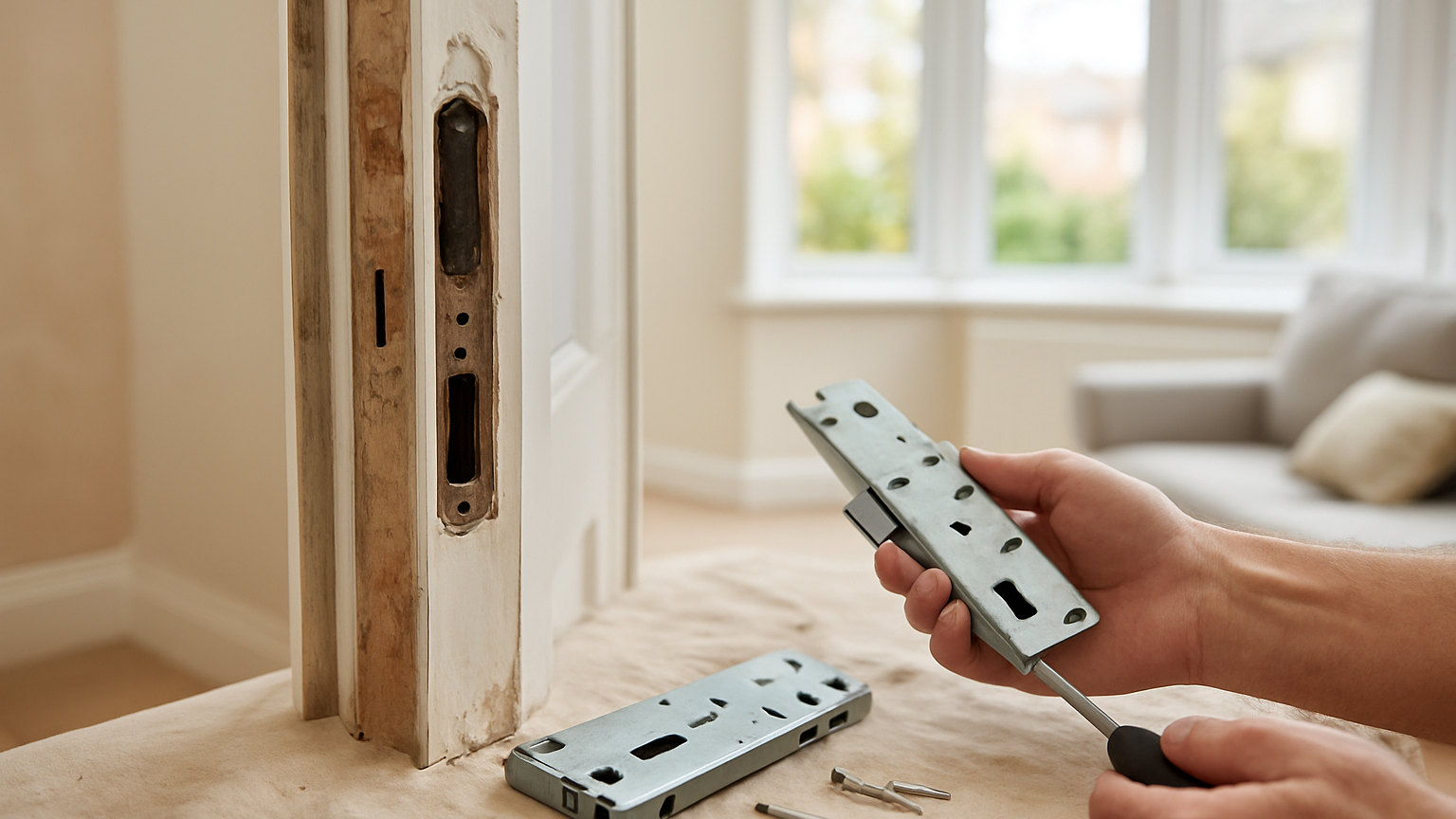
The gearbox is the central mechanism the handle and key operate, and it is the usual failure on a multipoint door.
Signs:
- The handle lifts with no resistance and nothing happens
- The handle will not lift at all, even with the door wide open
- A crunching or grinding sound when lifting the handle
- The key turns but does not deadlock
- Only some of the bolts throw
If it fails with the door open, it is the mechanism, not the alignment.
A gearbox can frequently be replaced on its own without changing the whole strip, and matching it requires the backset, the centres, the faceplate width and the bolt layout. Photograph everything and take the old unit to a supplier, or use a locksmith.
Step 8: prevent failure
- Always lift the handle fully before turning the key, and never force the key against a partly engaged mechanism
- Never slam a uPVC door with the handle lifted
- Keep the door properly adjusted, since misalignment puts strain on the gearbox
- Lubricate the mechanism and hinges with a dry lubricant twice a year
- Clean the keeps and the door edge
- Do not hang anything heavy on the handle
If it goes wrong
Adjusted and now worse: return the screws to the noted starting positions and work again in small steps.
Handle will not lift with the door open: gearbox failure. It needs replacing.
Door locked shut and will not open: do not force it. Call a locksmith, who can usually open it without damage.
Draughty despite adjustment: the seals may be perished. Replacement gaskets are available.
Hinge adjustment reaches its limit: the frame may have moved. Get it assessed.
A summary
- Test with the door open: if the mechanism works, it is alignment, not failure
- Hinges adjust in three directions: height, lateral and compression
- Note the starting positions and adjust a quarter turn at a time
- Adjusting the keeps is frequently quicker than adjusting hinges
- A handle that lifts with no resistance means the gearbox has failed
- Always lift the handle fully before turning the key


