
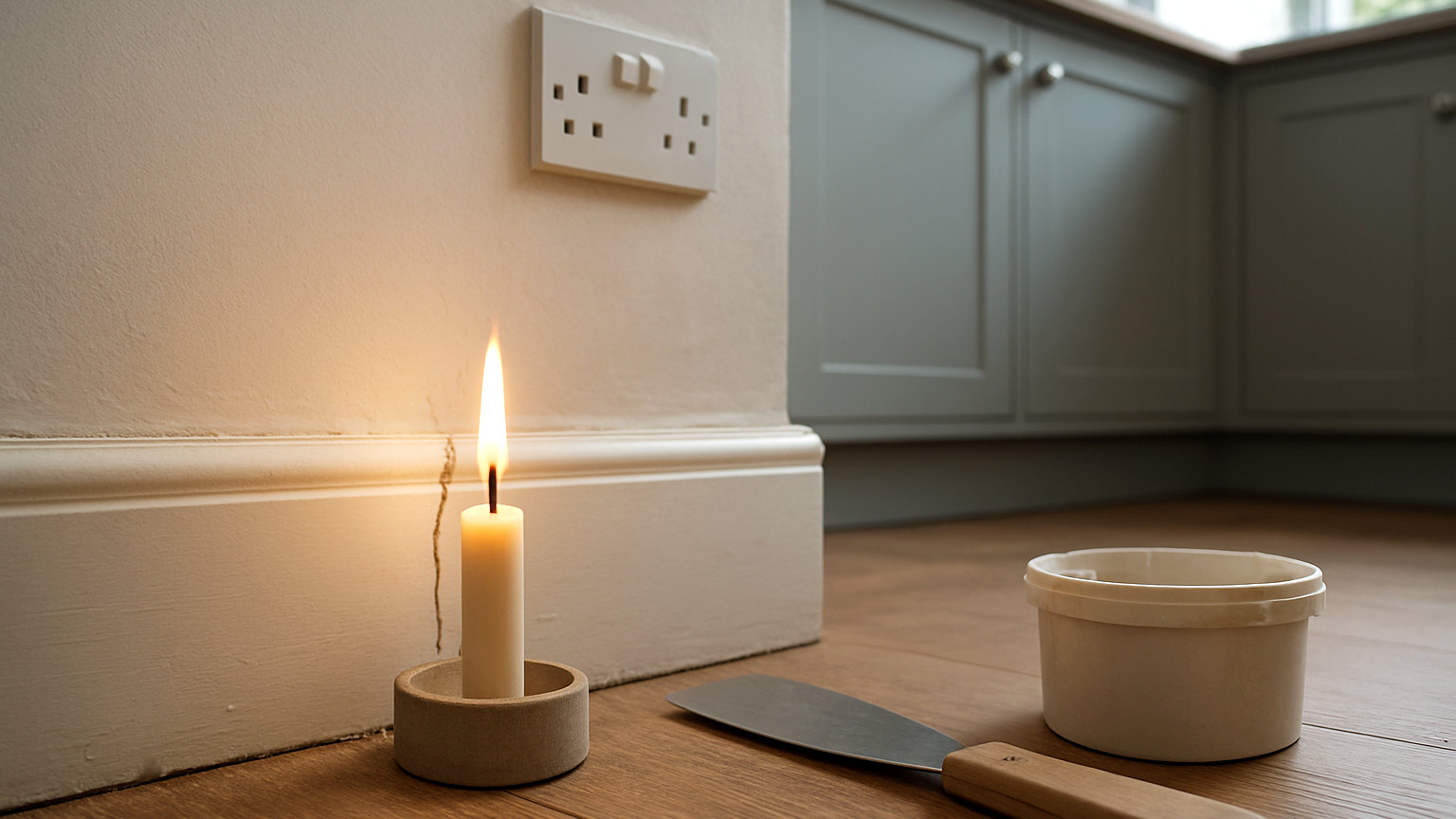
Before sealing anything, find out where the air is actually moving. Half an hour with a candle on a windy day locates most of it.
Draught or cold surface
Two different problems, frequently confused.
A draught is air moving through a gap. You feel it as a current, usually at ankle level or on exposed skin. It comes and goes with the wind.
A cold surface is a wall, window or floor at a lower temperature than the room. You feel heat radiating away from you towards it, which reads as a chill without any air movement. It is constant regardless of wind.
Sealing gaps fixes draughts. Only insulation fixes cold surfaces. Diagnosing which you have prevents spending money on the wrong thing.
What you need
- An incense stick, a candle, or a thin strip of tissue paper
- The back of your hand, which is more sensitive than the palm
- A thermometer, ideally an infrared one
- A hygrometer
- A torch
- A notepad and a pen
Step 1: pick the conditions
- A cold, windy day gives the biggest pressure difference and the clearest results
- Have the heating on so there is a temperature difference
- Close all windows and external doors
- Where you have a fan, turning on the bathroom and kitchen extractors depressurises the house slightly and exaggerates the draughts, which helps
Step 2: the smoke test
- Light an incense stick, or a candle and blow it out so it smokes
- Hold it close to the surface being tested, and move slowly
- Watch the smoke: it will be drawn towards a gap, or blown away from one
- Work methodically round each opening
- Mark every position you find with masking tape
- Note whether air is coming in or going out
A tissue strip taped to a stick works the same way and is safer near curtains.
Step 3: the checklist, room by room
Windows:
- All four edges of every opening casement
- The joint between the frame and the wall
- Around the glazing beads
- The meeting rails on a sash window
- Trickle vents, which are meant to let air in
Doors:
- All four edges
- The threshold, usually the biggest gap
- The letterbox and the keyhole
- Around the frame where it meets the wall
- Any cat flap
Floors:
- The gap between the skirting and the floor
- Gaps between floorboards
- Around pipes coming up through the floor
- Under a bay window
- At the perimeter of a suspended floor
Walls and ceilings:
- Around sockets and switches, particularly on external walls
- Around ceiling roses and downlights
- Where pipes and cables pass through
- Extractor fans and vents
- The loft hatch
Chimneys:
- Any open or disused fireplace
- Around a stove or a fire surround
Other:
- Under the stairs and in cupboards on external walls
- Around a boiler flue
- Behind kitchen units on external walls
- Around soil pipes and waste pipes
- Where an extension joins the original house
Step 4: find the cold surfaces
An infrared thermometer makes this straightforward and costs very little.
- With the heating on and the house at a steady temperature, measure the room air temperature
- Measure the surface temperature of each wall, window and floor
- Note anywhere significantly colder than the rest
- Check external walls against internal ones
- Check corners, which are colder than the middle of a wall
- Check above and below windows
- Check the ceiling in an upstairs room, which shows insulation gaps
A cold patch on an otherwise warm wall usually means a gap in the insulation, or a thermal bridge.
Step 5: check the loft
- Go up with a torch and stay on the joists
- Look for gaps and thin patches in the insulation
- Look for insulation pushed aside, walked on or compressed
- Check around the hatch, where it is frequently missing
- Check whether it reaches the eaves without blocking them
Step 6: record it
- Sketch each room and mark every finding
- Note whether it is a draught or a cold surface
- Rate each one by how much air is moving
- Photograph anything you will want to find again
- Keep the list, and tick things off
Working from a list gets the whole house done. Working from memory gets one window done.
Step 7: prioritise
Deal with the biggest gaps first, which are usually:
- Loft hatch and loft insulation gaps
- An open, unused chimney
- The threshold of external doors
- Suspended floor perimeters and floorboard gaps
- Old window frames
- Service penetrations
Before you seal anything
Some of what you find is deliberate ventilation and must stay.
- Air bricks and underfloor vents
- Wall vents in a room with a fuel-burning appliance
- Trickle vents
- Extractor fans
- The gap under a bathroom or kitchen door
Identify these during the survey and mark them as not to be sealed.
If it goes wrong
Cannot feel anything on a still day: wait for wind, or run the extractors to depressurise the house.
Cold but no air movement: a cold surface, not a draught. Insulation is the answer.
Draught with no obvious source: air travels inside walls and floors. Check the nearest penetration.
Whole house feels draughty: start with the loft, the chimney and the floors.
Found a vent you want to seal: check what it serves before touching it.
A summary
- Test on a cold windy day with the heating on and everything closed
- A draught moves air; a cold surface radiates. They need different fixes
- Work the checklist room by room and mark every finding with tape
- Use an infrared thermometer to find cold surfaces and thermal bridges
- Prioritise the loft, the chimney, the thresholds and the floors
- Identify the deliberate vents first and mark them as not to be sealed


