
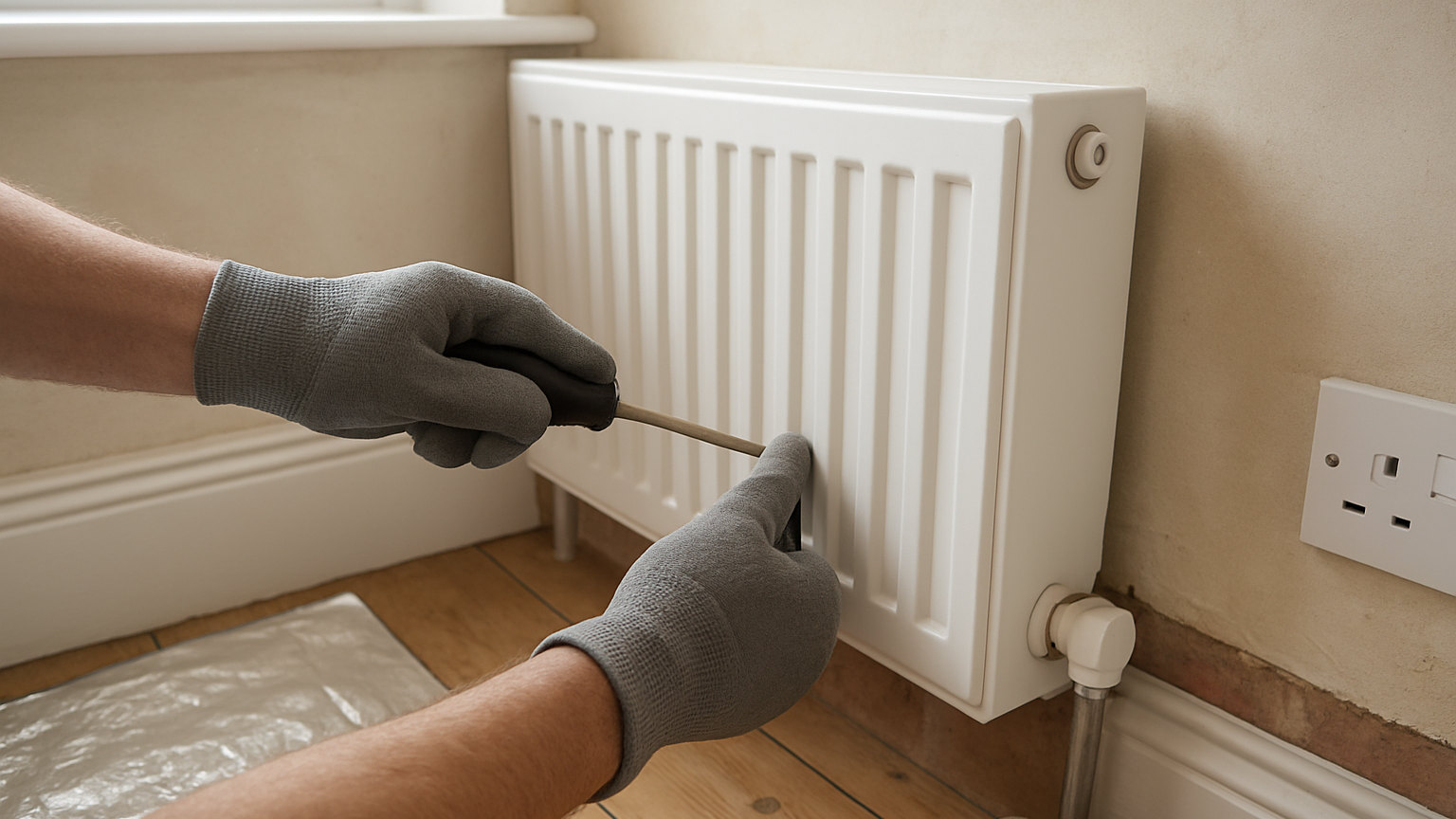
Before replacing radiators or a boiler, there are several cheap measures that get more out of what is already there.
Step 1: clear the front
The simplest and most commonly ignored.
- A radiator warms a room by convection, drawing cool air in at the bottom and releasing warm air at the top, and by radiation from its face
- A sofa in front of a radiator absorbs the heat and blocks the airflow
- Long curtains hanging over a radiator send the heat straight up behind them and against a cold window
- A radiator cover restricts both radiation and convection
- Anything drying on a radiator blocks it and adds moisture to the room
- Move furniture at least a hand's width clear of the front
- Shorten curtains to the sill, or fit them so they finish above the radiator
- Remove or modify radiator covers where you can
- Keep the top clear
Step 2: reflective panels
For radiators on external walls.
- A radiator on an external wall radiates heat backwards into a cold wall
- A reflective panel behind it returns that heat into the room
- Cheap, and it fits behind the radiator without removing it
- Most worthwhile on a solid or uninsulated wall, where the loss is greatest
- Less worthwhile behind an insulated cavity wall, where there is less to reclaim
- Measure the radiator
- Cut the panel slightly smaller
- Slide it down behind, or fix it with the supplied fittings or adhesive strips
- Make sure the reflective face points into the room
- Leave the air gap behind the radiator clear
A radiator shelf above a radiator under a window also helps, by deflecting the rising warm air out into the room rather than up the cold glass.
Step 3: use the controls properly
The room thermostat controls the whole system and should be in a representative room, away from draughts, direct sun and any heat source.
- Set it to the lowest temperature that is comfortable
- Each degree lower makes a measurable difference to consumption
- Turning it up does not heat the house faster; it heats it to a higher final temperature
Thermostatic radiator valves control individual rooms.
- They sense the air temperature around the valve and close as the room reaches the setting
- The numbers are settings, not temperatures
- Turn them down in rooms used less, and do not turn them fully off in a room that could get damp
- Do not fit a TRV in the room with the main thermostat, or the two fight each other
- Keep TRVs unobstructed by curtains and furniture, or they will read the wrong temperature
- Exercise them fully open and closed at the end of summer, so the pin does not seize
The programmer sets the times. Heating a house steadily to a lower temperature is generally more comfortable and frequently more economical than short bursts to a high one, particularly in a well-insulated house.
Step 4: bleed and balance
- Bleed any radiator cold at the top: it has trapped air
- Check the boiler pressure afterwards and repressurise to around 1.5 bar if needed
- Balance the system where near radiators are hot and distant ones are cool: close each lockshield and open it progressively more as you move away from the boiler
- A radiator cold at the bottom has sludge, not air, and needs flushing
Step 5: lower the flow temperature
One of the most effective free changes on a modern condensing boiler.
- A condensing boiler is most efficient when the return water temperature is low enough for it to condense
- Many are set at the factory or by an installer to a high flow temperature, at which they rarely condense
- Reducing the flow temperature, commonly to around 55 to 60 degrees for heating, allows condensing operation
- The house heats more slowly and more steadily, which suits continuous rather than intermittent operation
- Radiators feel cooler to the touch and still deliver the heat over a longer period
This is the heating flow temperature, not the hot water temperature. Hot water storage has its own requirements and should not be reduced without advice, since stored water needs to reach a temperature that controls bacterial growth.
Where the house does not reach temperature after the change, the radiators may be undersized for a lower flow temperature. Raise it back and take advice.
Step 6: insulate the pipework
- Lag primary pipes in unheated spaces: loft, garage, under floors
- Lag the pipes at the boiler and the cylinder
- Fit a hot water cylinder jacket, or upgrade a thin one. Among the fastest-paying measures available
- Use insulation of the correct bore, fitted with no gaps and taped at joints and bends
Step 7: check the radiator suits the room
- A radiator that runs hot and still leaves the room cold may simply be too small
- Room heat loss depends on size, insulation, glazing and exposure
- An extension or a converted room frequently has a radiator sized for the old arrangement
- A larger or a double-panel radiator may be the answer
- Adding radiators affects the system as a whole and is worth getting checked
Step 8: maintenance
- Vacuum dust from between the fins and the convector plates, which reduces output when clogged
- Have a corrosion inhibitor in the system and top it up after any drain-down
- Consider a magnetic filter, cleaned annually
- Have the system serviced annually
- Exercise TRVs at the end of summer
If it goes wrong
Room still cold with a hot radiator: the radiator may be undersized, or the room is losing heat faster than it is being supplied.
House will not reach temperature after lowering the flow: raise it back and take advice on radiator sizing.
TRV not closing: the pin may be seized. Remove the head and free it.
Some rooms hot, others cold: the system needs balancing.
Radiator cold at the bottom: sludge. Bleeding will not help.


