
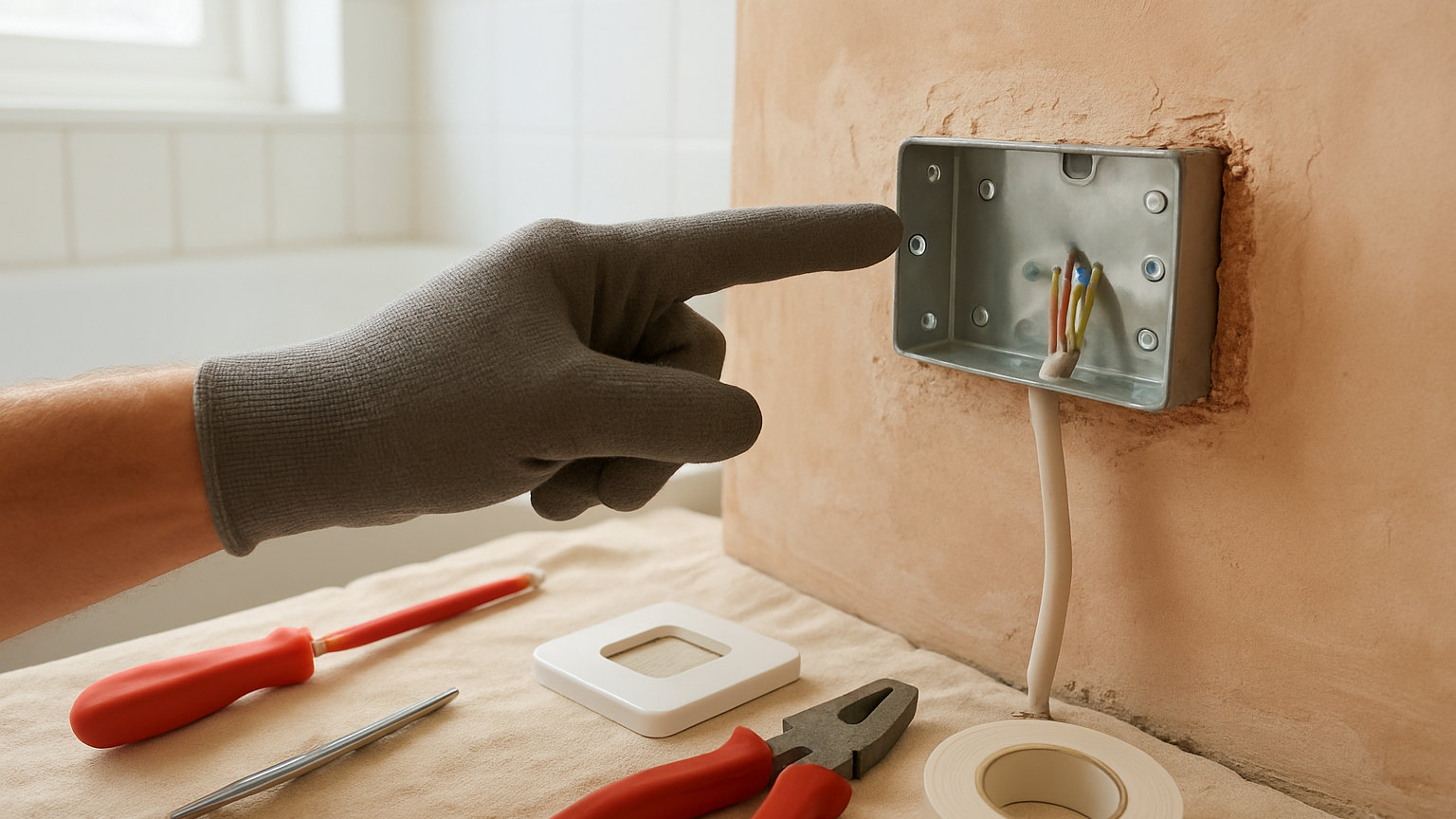
A room containing a bath or shower is a special location under the wiring regulations. Water and electricity together lower the resistance of the human body, so the rules are stricter and the work is notifiable.
The legal position first
Any addition or alteration to a circuit in a room containing a bath or shower is notifiable work under Building Regulations, throughout the UK.
That means it must be carried out by a registered electrician who certifies it, or notified to building control in advance.
Replacing a like-for-like accessory is generally treated as maintenance rather than an alteration, and given the risk, using an electrician is the sensible course in a bathroom regardless.
This article explains the rules so you can understand what is being proposed and check the work is right. It is not a guide to doing it yourself.
The zones
The regulations divide a bathroom into zones by distance from the water.
Zone 0: inside the bath tub or the shower tray itself.
- Only SELV equipment at very low voltage, maximum 12V AC, with the source outside the zones
- Minimum IPX7, protected against immersion
Zone 1: above the bath or shower, to a height of 2.25m above the floor.
- Minimum IPX4, protected against splashing
- Electric showers, shower pumps and suitable light fittings are permitted
- Higher IP rating where water jets may be used
Zone 2: an area extending 0.6m beyond zone 1, and 2.25m above the floor. Also the area around a washbasin within 0.6m of the tap.
- Minimum IPX4
- Light fittings, extractor fans and shaver sockets to BS EN 61558-2-5 are permitted
Outside the zones: the rest of the room. Ordinary fittings may be used, with conditions.
IP ratings
Two digits: the first for solid objects, the second for water. An X means not rated for that.
- IPX4: splashing from any direction. The bathroom minimum for zones 1 and 2
- IPX5: water jets
- IPX7: temporary immersion
- IP65: dust tight and protected against jets
Check the rating marked on any fitting before it goes in a bathroom.
Sockets
Socket outlets are not permitted within 3m of the boundary of zone 1, which in most domestic bathrooms rules them out entirely.
The exceptions:
- Shaver supply units to BS EN 61558-2-5, which contain an isolating transformer. Permitted in zone 2 and beyond, subject to the manufacturer's instructions
- SELV socket outlets
An ordinary 13A socket in a bathroom is not permitted.
Switches
- An insulated pull cord switch is the usual solution inside a bathroom
- A plate switch outside the door is the alternative
- Ordinary plate switches are not permitted within the zones
RCD protection and bonding
All circuits serving a bathroom require 30mA RCD protection.
Supplementary bonding connects exposed metalwork together so it cannot be at different potentials. It may be omitted where certain conditions are met, including RCD protection of all circuits and satisfactory main bonding, and that is a judgement for the electrician to make and record.
In an older bathroom, look for green and yellow bonding conductors clamped to pipework. They should not be removed during a refit without the electrician confirming they are not required.
Extractor fans
- Choose the IP rating for the zone it is being fitted in
- A fan in zone 1 must be suitable for that zone
- Fans require a means of isolation, commonly a three-pole fan isolator switch outside the room
- Installation is notifiable
Electric showers
- A dedicated high-current circuit, typically 40A or above, with cable sized to the load
- A pull cord isolator inside the room, or a switch outside
- RCD protection required
- Definitively an electrician's job, and notifiable
What you can do yourself
- Change a lamp in an existing fitting, with the power off
- Clean a fan grille, with the circuit isolated
- Replace a like-for-like fitting, and using an electrician is the safer course
Everything beyond that: use a registered electrician and get the certificate.
Warning signs in an existing bathroom
- An ordinary 13A socket
- A plate switch inside the room
- A light fitting with no IP rating
- A fan with no isolator
- No RCD protection on the board
- Bonding conductors cut or disconnected
Any of these warrants an inspection.
If it goes wrong
Existing socket in a bathroom: do not use it. Have it removed by an electrician.
Fitting has no IP rating: it should not be in the zones. Replace it.
No RCD protection: get the board assessed.
Bonding removed during a refit: have an electrician confirm whether it was required.
Work done without certification: an EICR will establish the condition and give a record.
A summary
- All circuit work in a bathroom is notifiable throughout the UK
- Zone 0 is inside the bath or tray; zone 1 above it to 2.25m; zone 2 extends 0.6m beyond
- IPX4 is the minimum for zones 1 and 2
- No ordinary socket within 3m of zone 1, other than a compliant shaver unit
- All bathroom circuits need 30mA RCD protection
- Use a registered electrician and keep the certificate
Planning a bathroom refit
Get the electrician involved early rather than at the end.
- Decide the layout, including where the shower, fan, lighting and any shaver point go
- Have the electrician confirm the zones for that layout before anything is fixed
- Agree what needs first fixing before the walls are closed up and tiled
- Check the consumer unit can accommodate any new circuit
- Book the second fix and the certification into the programme
Retrofitting a cable after the tiling is finished is expensive and avoidable.


