
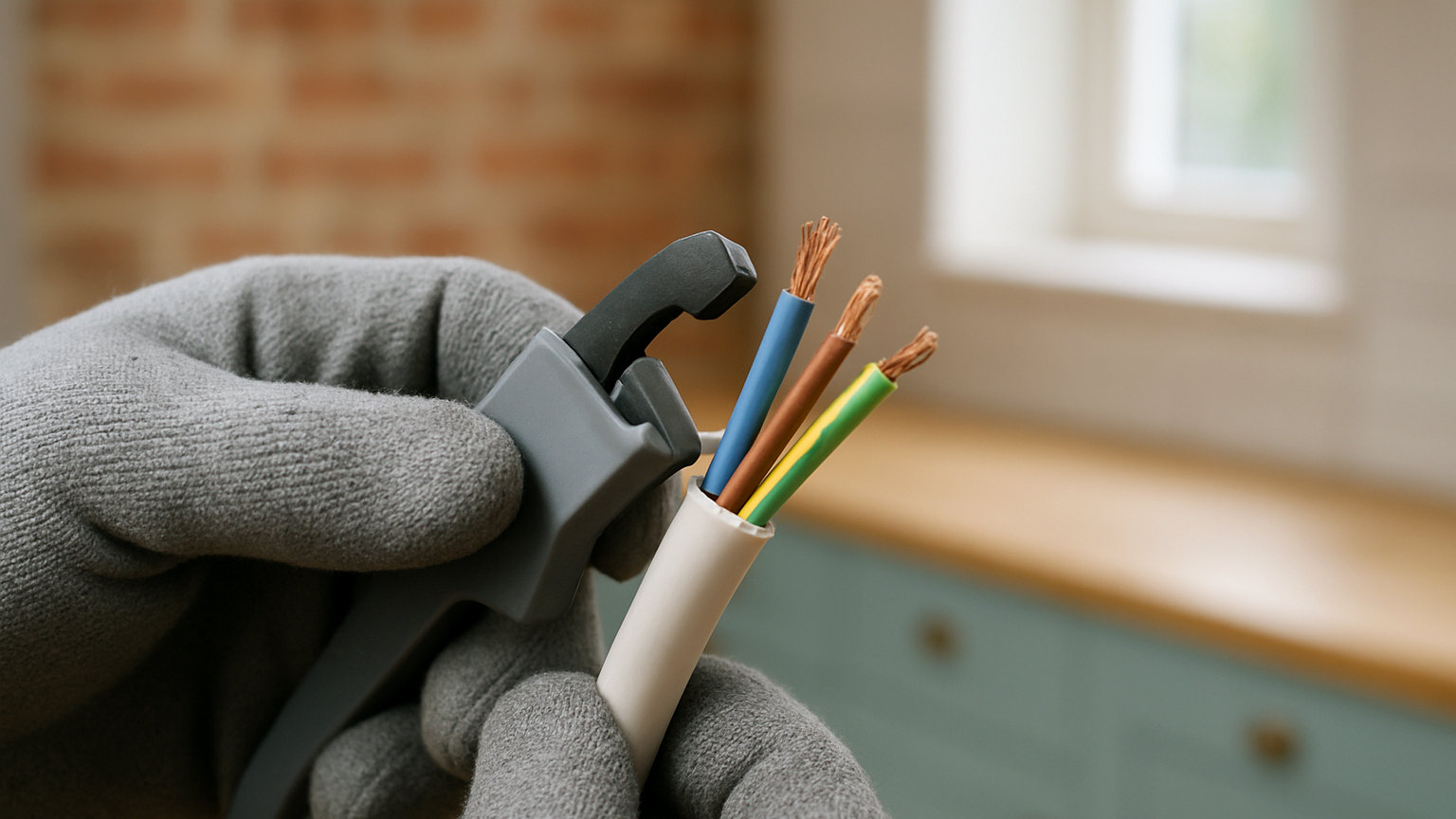
UK cable colours changed in the mid 2000s. Both sets are still present in houses, and in some houses both are present in the same circuit.
Current colours, since 2006
Fixed wiring:
- Brown: line, commonly called live
- Blue: neutral
- Green and yellow: earth
Flexible cords on appliances use the same colours, and have done since the 1970s.
Old colours, before 2006
Fixed wiring:
- Red: live
- Black: neutral
- Green, or green and yellow: earth
Plain green earth indicates wiring from before about 1977.
The dangerous overlap
Black means neutral in the old system and is not used in the new one. Blue means neutral in the new system.
The trap is a house rewired or extended partway through the change, where old and new cable meet.
Never assume a colour. Always prove dead before touching anything.
Where both systems are present, there should be a warning label at the consumer unit stating that the installation uses two sets of colours.
Twin and earth
The standard cable for domestic fixed wiring: a flat grey sheath containing two insulated conductors and a bare earth.
- Brown and blue, plus a bare copper earth, in modern cable
- Red and black, plus a bare earth, in older cable
- The earth conductor is bare and must be sleeved in green and yellow wherever it is exposed in an accessory or a box
An unsleeved earth in a socket box is a common fault in amateur work.
Switch lines and sleeving
The point that causes most confusion.
In a lighting circuit, the cable from the ceiling to the switch carries a live down and a switched live back up. Twin and earth has only two conductors, so the blue, or black in old cable, is used as the switched live.
That conductor must be identified with brown sleeving, or red in older installations, at both ends, to show it is not a neutral.
- A blue conductor with brown sleeve is a switched live
- A black conductor with red sleeve is a switched live in old wiring
- An unsleeved blue or black at a switch may still be live
This is why proving dead matters more than reading colours.
Three-core and earth
Used for two-way switching, where a light is controlled from two places.
- Modern: brown, black and grey, plus earth
- Old: red, yellow and blue, plus earth
- In three-core, black and grey are line conductors, not neutrals
- They should be sleeved brown where used as lines
Finding a black or grey conductor in three-core and assuming it is neutral is a serious error.
Cable sizes
Quoted as the cross-sectional area of the conductors in square millimetres.
- 1.0mm² and 1.5mm²: lighting circuits
- 2.5mm²: ring final circuits for sockets
- 4mm² and 6mm²: cooker circuits, radials, immersion heaters
- 10mm² and above: electric showers and larger loads
The correct size depends on the load, the length of the run, the method of installation and the protective device. It is not simply a matter of picking a size.
Other cable types
- Three-core and earth: two-way switching
- SWA, steel wire armoured: outdoor and buried runs, to a garage or shed
- Flex: flexible cord for appliances and pendants, in brown, blue and green and yellow
- Heat resistant flex: for light fittings, where the temperature is higher
- Fire rated cable: for alarm systems and certain circuits
Older wiring worth recognising
- Rubber insulated cable, frequently with a fabric braid. Typically pre-1960s. The rubber perishes and crumbles, exposing conductors. Have it inspected urgently
- Lead sheathed cable: pre-war, obsolete
- Round sheathed cable: older than modern flat twin and earth
- No earth conductor at all in lighting circuits, common in older installations
- Round-pin sockets: a pre-1947 installation still in use
Any of these means the installation is due for assessment, and probably a rewire.
Before touching anything
- Switch off at the consumer unit
- Lock off the breaker
- Prove dead with an approved voltage indicator, using the prove, test, prove method
- Photograph the connections before disturbing them
- Label the conductors before disconnecting
- Never rely on colour alone
If it goes wrong
Both colour systems in one box: a mixed installation. Label carefully and get it checked.
Blue conductor reading live: it is a switched live that has not been sleeved.
No earth in a lighting circuit: common in older houses. A metal fitting must not be installed without one.
Rubber or fabric insulation: stop and get an electrician. It is well beyond its life.
Cannot work out the circuit: stop. Guessing with electricity is not worth it.
A summary
- Brown live, blue neutral, green and yellow earth, since 2006
- Red live, black neutral before that
- Black means neutral in the old system and line in three-core, which is the trap
- A blue or black conductor sleeved brown or red is a switched live
- A bare earth must be sleeved green and yellow wherever it is exposed
- Prove dead rather than trusting any colour
When wiring needs replacing
Colour alone does not date an installation reliably, and some findings do.
- Rubber or fabric insulated cable: well past its life
- No earth in lighting circuits
- Round-pin sockets
- A rewireable fuse board with no RCD
- Cable that is brittle, cracked or crumbling when flexed
- Sockets or switches that are warm, scorched or cracked
An Electrical Installation Condition Report establishes the condition of what is there and gives a documented basis for deciding what needs doing.
Reading a junction box
Junction boxes concentrate several cables in one place and are worth approaching carefully.
- Maintenance-free connectors may be buried in a wall or ceiling; traditional screw-terminal boxes must remain accessible
- A box found buried behind plaster with screw terminals is a fault worth reporting
- Photograph before disturbing anything
- Conductors of the same colour in one terminal are not necessarily doing the same job


