
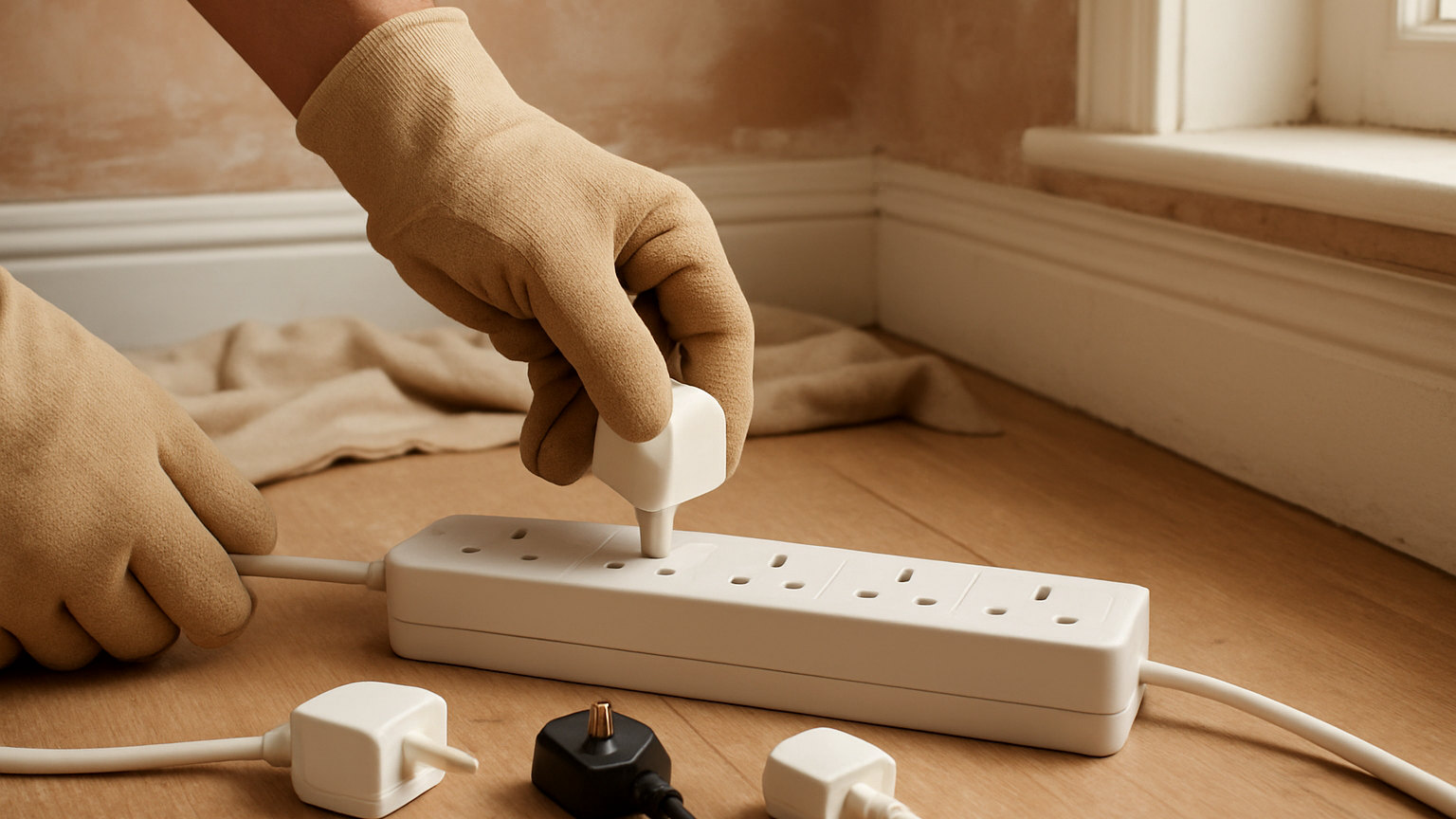
An extension lead is rated for its total load, not for each socket on it. That single misunderstanding causes a substantial number of house fires.
The rating
A standard UK four-way extension lead is protected by a 13A fuse in its plug and is rated at 13A in total across all its sockets.
Not 13A each. Thirteen amps shared.
13A at 230V is approximately 3000 watts, or 3kW, in total.
What appliances draw
Approximate figures, worth knowing.
- Kettle: 2 to 3kW
- Fan heater or oil-filled radiator: 2 to 3kW
- Toaster: 1 to 2kW
- Iron: 2 to 3kW
- Microwave: 1 to 1.5kW
- Tumble dryer: 2 to 3kW
- Washing machine: 2 to 3kW while heating
- Vacuum cleaner: 0.8 to 1.5kW
- Hair dryer: 1.5 to 2kW
- Television: 0.05 to 0.2kW
- Laptop or phone charger: under 0.1kW
- Lamp with an LED bulb: under 0.01kW
Two high-load appliances on one extension lead exceeds its rating. A kettle and a heater together is already over 5kW on a lead rated for 3kW.
How to work it out
- Find the wattage on each appliance's rating plate
- Add the wattages of everything that will run at the same time
- Keep the total below 3000W on a 13A lead
- Or convert: watts divided by 230 gives amps, and the total must stay under 13
- Where the lead is fused at less than 13A, use that figure instead
Low-power electronics can be multiplied up freely. High-power heating appliances cannot.
Cable drums
The most dangerous common misuse.
A cable drum must be fully unwound before drawing any significant load.
- Coiled cable cannot dissipate heat, so it heats up rapidly under load
- The insulation softens, melts and can ignite
- Drums carry two ratings: a much lower one when coiled and the full one when fully extended
- Check the label; a drum rated 13A extended may be rated only 3A or so wound
- Unwind it completely, even for a short job
What not to do
- Do not daisy chain: plugging one extension lead into another. Each connection adds resistance and heat, and the total load is easily exceeded
- Do not plug a multi-way adaptor into an extension lead
- Do not use block adaptors, the cube type that plug straight into a socket. They put weight on the socket and offer no fuse protection per outlet
- Do not run leads under carpets or rugs, where heat cannot escape and damage is invisible
- Do not run leads through doorways where they are crushed
- Do not use an indoor lead outdoors
- Do not use a damaged, taped or repaired lead
- Do not cover a lead with furniture or bedding
Warning signs
Stop using it immediately if:
- The plug, lead or socket feels warm
- There is any scorching, discolouration or melting
- You can smell burning or hot plastic
- The lead is frayed, cut or has exposed conductors
- The plug is loose in the socket
- It buzzes or crackles
Warmth is the early warning. Do not wait for anything more.
Choosing a lead
- Buy from a reputable supplier and look for BS 1363 compliance
- Choose one with individually switched sockets, useful for reducing standby load
- Choose one with surge protection for computers and televisions
- Buy the right length rather than coiling excess
- Choose one with a moulded plug
- Very cheap unbranded leads and adaptors are a poor economy
Where extension leads are the wrong answer
A permanently used extension lead is a sign that a socket is missing.
- Behind a television or a desk with several devices
- In a kitchen with insufficient worktop sockets
- Running to a shed, garage or outbuilding
- Anywhere it is trapped, covered or trailing across a walkway
Adding sockets on an existing suitable circuit is generally non-notifiable in England, outside special locations, and is a straightforward job for an electrician. It is safer, tidier and permanent.
High-load appliances
Some appliances should be plugged directly into a wall socket, never into an extension lead.
- Heaters of any kind
- Tumble dryers and washing machines
- Dishwashers
- Air conditioning units
- Anything drawing more than about 2kW continuously
If it goes wrong
Lead or plug warm: unplug immediately, reduce the load, and replace the lead.
Fuse keeps blowing in the lead: it is overloaded, or an appliance is faulty.
Smell of hot plastic: unplug at the wall and do not use it again.
Needing extension leads permanently: have additional sockets installed.
Drum getting hot: unwind it fully.
A summary
- A four-way lead is 13A in total, not per socket, which is about 3kW
- Add up the wattage of everything running at once
- Two high-load appliances on one lead exceeds it
- Unwind cable drums completely, every time
- Never daisy chain leads or adaptors
- Warmth is the early warning; stop using it
Checking your leads
Worth doing once a year, and it takes ten minutes.
- Unplug each lead and run it through your hands along its full length, feeling for damage
- Check the plug for cracks, bent pins and scorching
- Check the fuse rating in the plug
- Check the sockets on the lead for damage and for anything loose
- Check nothing is running under a rug or behind a radiator
- Bin anything damaged rather than taping it
Standby and switched sockets
A lead with individually switched sockets is useful beyond convenience.
It lets you turn off items left on standby without unplugging them, and it means a single switch isolates a whole desk or television setup.
It also makes it obvious what is actually drawing power, which is a useful habit when working out what is on a circuit.


