
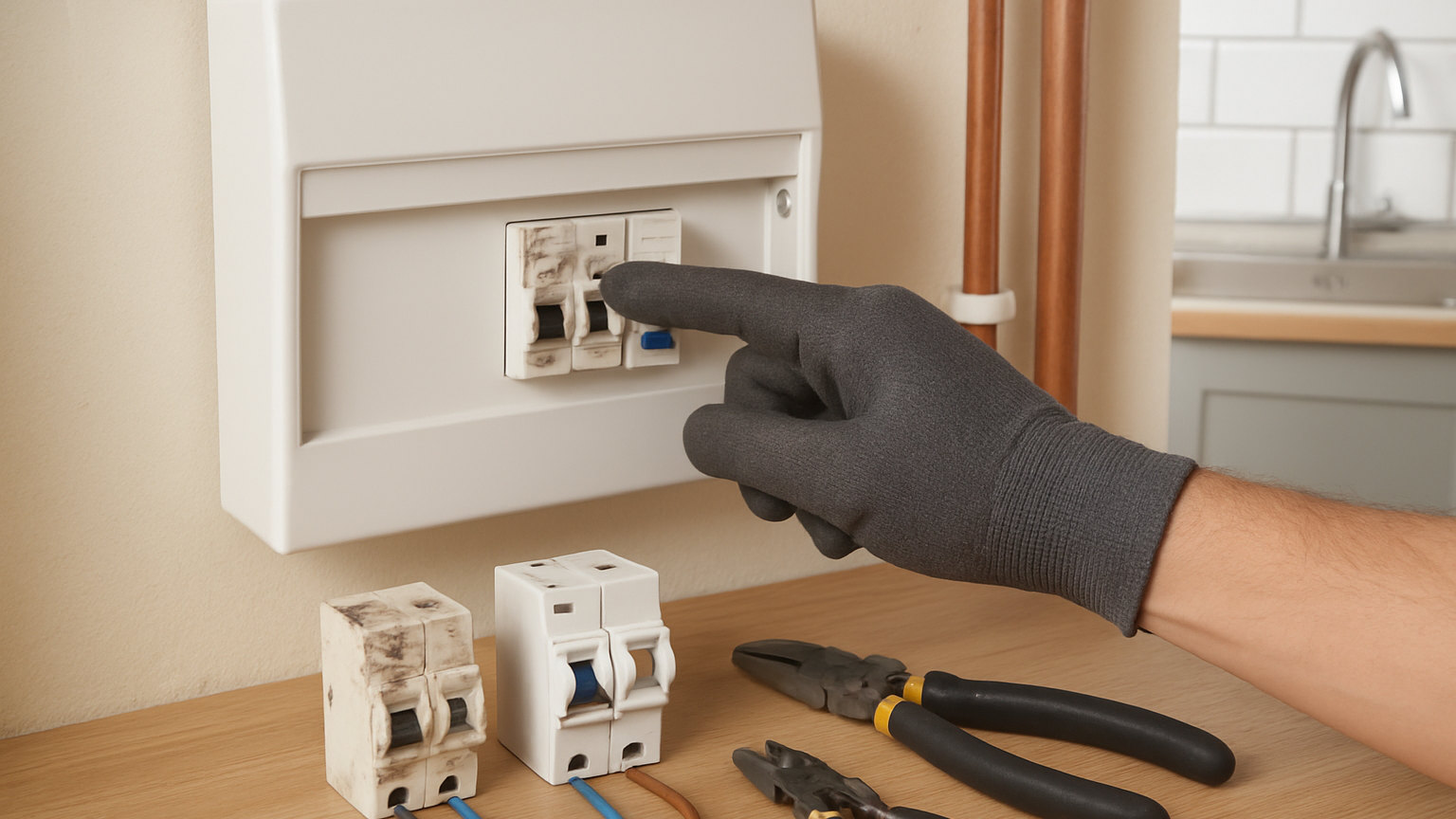
An MCB and an RCD do completely different jobs. Knowing which is which explains why an older installation without RCD protection is worth upgrading.
What each device protects
An MCB protects the cable. It trips when the current exceeds its rating, preventing the cable overheating and causing a fire. It does not detect current flowing through a person.
An RCD protects people. It compares the current flowing out on the live with the current returning on the neutral. If they differ, current is escaping somewhere else, frequently to earth through a person or through moisture. It disconnects in a fraction of a second.
An RCBO combines both in one device, protecting a single circuit.
What 30mA means
Domestic RCDs used for personal protection are rated at 30 milliamps, which is thirty thousandths of an amp.
That is a very small imbalance, chosen because it is below the level at which a shock is likely to be fatal, and it disconnects fast enough to limit the effect.
For comparison, a 32A MCB will not trip until the current is a thousand times greater.
An MCB will not protect you from a shock. An RCD will.
What an RCD does not do
- It does not protect against a shock received between live and neutral, for instance by touching both conductors. The current is balanced, so it sees nothing
- It does not replace an MCB, since it does not protect against overload
- It does not make bad wiring safe
It is one layer of protection, not the whole of it.
Where RCD protection is required
Under current wiring regulations, additional protection by a 30mA RCD is required in a wide range of domestic situations, including socket outlets, circuits in bathrooms, and cables buried in walls at shallow depth.
An older installation predating those requirements may have no RCD protection at all.
Testing an RCD
Test every RCD and RCBO twice a year. That is the purpose of the test button.
- Warn everyone in the house, since power will be cut
- Save any computer work and shut equipment down
- Press the button marked T or Test
- The device should trip immediately
- Switch it back on
- Reset clocks and timers, and check the boiler, freezer and any alarm have restarted
If it does not trip, it is not protecting anyone. Call an electrician.
Some boards have a single test button for a main RCD; a board of RCBOs has one on each device.
Split load and full RCBO boards
A split load board has two RCDs, each protecting a group of circuits. A fault on one circuit takes out everything on that RCD, which may be half the house including the freezer and the heating.
A board of RCBOs protects each circuit individually. A fault takes out only that circuit. More expensive and far more convenient, and better for fault finding.
Where a board is being replaced, RCBOs throughout are worth the difference.
Nuisance tripping
An RCD that trips without an obvious fault usually has a real cause.
- A single faulty appliance, most often a heating element
- Cumulative leakage: many appliances each leaking a tiny amount, adding up to 30mA. Common on a board with only two RCDs
- Water ingress in an outdoor socket, an external light or a damaged cable
- Deteriorating insulation in old wiring
- A failing RCD itself
Splitting circuits across more devices, or fitting RCBOs, is the usual remedy for cumulative leakage.
Other types
- RCD socket: a socket outlet with built-in RCD protection, useful for outdoor equipment where the circuit has none
- Plug-in RCD adaptor: a portable device for garden tools. Always use one with a mower, hedge trimmer or any outdoor power tool unless the circuit is already RCD protected
- 100mA and 300mA RCDs: used for fire protection rather than personal protection, sometimes as a main switch
- AFDD, arc fault detection device: detects arcing faults that other devices miss, increasingly recommended
Should an old board be upgraded
Consider it if:
- There is no RCD protection at all
- The board has rewireable fuses
- It is in a wooden enclosure
- There are signs of overheating
- You are having other work done, or a rewire
- An EICR has recommended it
Replacing a consumer unit is notifiable work and must be done by a registered electrician.
It usually involves testing the existing circuits, which can reveal faults that need addressing first.
If it goes wrong
RCD will not reset: the fault is still present. Unplug everything on the affected circuits.
Does not trip on test: it has failed. Call an electrician.
Trips constantly: systematic elimination of appliances, then an electrician.
No RCD on the board: use plug-in RCD adaptors for outdoor tools and get the board assessed.
Trips whenever the immersion comes on: the element is almost certainly failing.
Using RCD protection outdoors
Garden tools are the highest-risk everyday use of electricity in a home: wet grass, a long trailing lead and a cutting blade.
- Always use RCD protection with a mower, hedge trimmer, strimmer or pressure washer
- Where the socket circuit already has 30mA protection, that is sufficient
- Where it does not, use a plug-in RCD adaptor at the socket
- Test the adaptor before each use with its test button
- Keep the lead behind you and out of the cutting path
- Do not use electric garden tools in the rain or on wet grass
A summary
- An MCB protects the cable; an RCD protects people
- 30mA is the domestic rating for personal protection
- Test every RCD and RCBO twice a year with the test button
- A device that does not trip on test is not protecting anyone
- Cumulative leakage from many appliances is a common cause of nuisance tripping
- Always use RCD protection with outdoor power tools


