
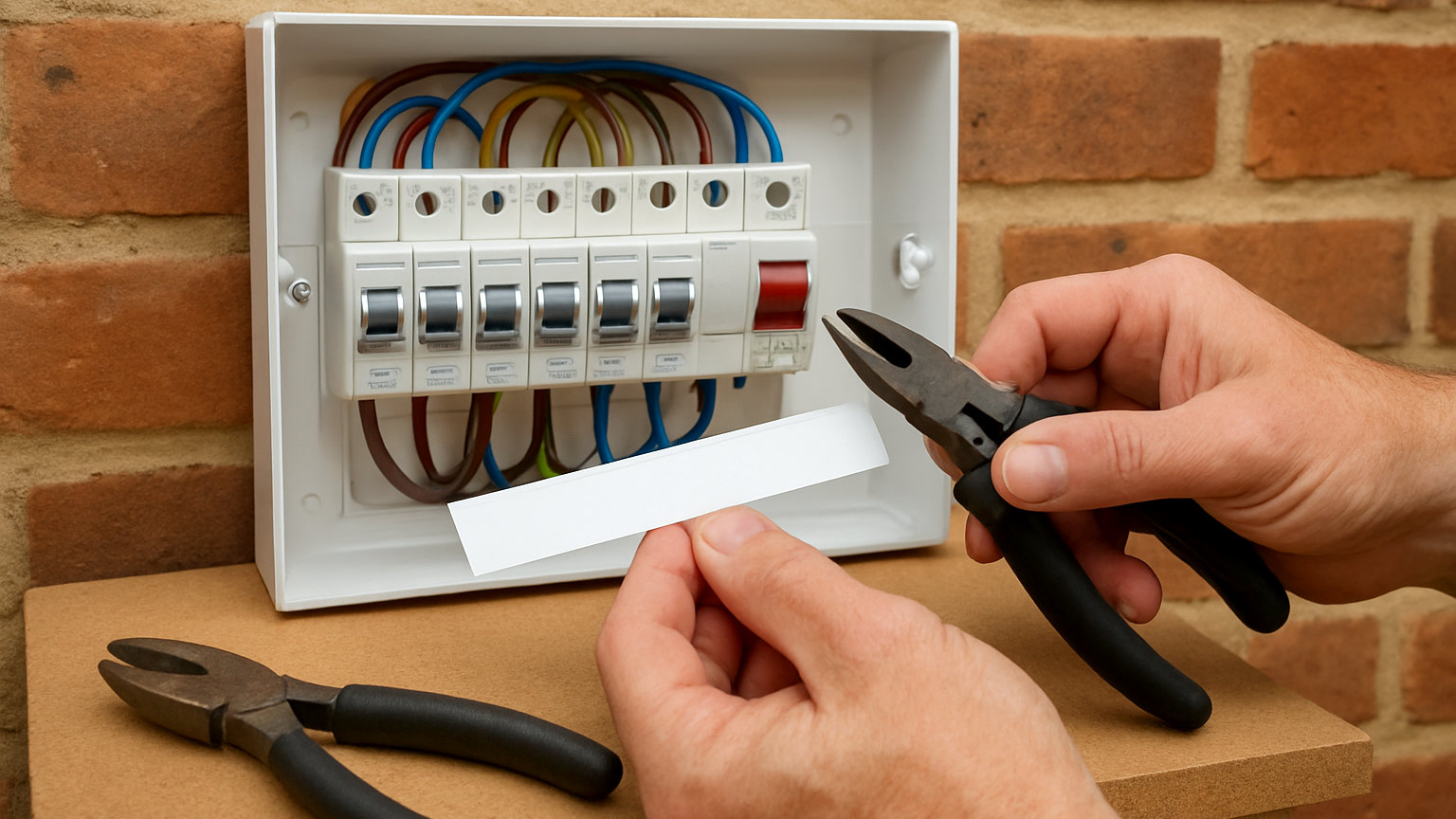
The consumer unit, still commonly called the fuse box, is where the electricity supply is distributed around the house and where every circuit can be switched off.
Find it and label it
Usually in a hallway, under the stairs, in a garage, a porch or a cupboard, close to the electricity meter.
Ten minutes labelling it properly is worth doing now.
- Turn the main switch off, then on again, so you know it works
- Switch off one breaker at a time and walk round the house noting what has gone off
- Write each one on a label: upstairs lights, downstairs sockets, cooker, shower, and so on
- Fix the labels to the unit where they can be read
- Keep a torch nearby
Do this before you need it, not in the dark with something sparking.
What is inside
The main switch. A large double-pole switch turning off the whole installation. This is the one to use in an emergency.
MCBs, miniature circuit breakers. Small switches, one per circuit, that trip on overload or a short circuit. They protect the cable from overheating.
RCDs, residual current devices. Detect a small imbalance between live and neutral, which indicates current leaking to earth, frequently through a person. They protect people rather than cables.
RCBOs. A combined MCB and RCD in one device, protecting a single circuit. A board of RCBOs means a fault takes out one circuit rather than half the house.
SPD, surge protection device. Found in newer boards, protecting equipment from voltage surges.
Reading the ratings
Each MCB is marked with a number, its rating in amps.
- 6A: lighting circuits
- 16A: immersion heater, a dedicated appliance
- 20A: a radial socket circuit, or a boiler
- 32A: a ring final circuit for sockets, or a small cooker
- 40A or 45A: a cooker or an electric shower
- 50A and above: a larger shower
There is also a letter, usually B or C, describing how quickly it responds to a surge. Domestic circuits are normally type B.
Never fit a higher-rated breaker to stop nuisance tripping. The rating protects the cable, and a larger one lets the cable overheat.
Older boards
Rewireable fuses: ceramic or plastic carriers with fuse wire inside. Functional and long obsolete. No RCD protection, so no protection against electric shock.
Cartridge fuses: a step on from rewireable, still without RCD protection.
A wooden backboard or a wooden enclosure: obsolete and a fire risk.
No RCD at all: the most significant shortcoming in an older board.
Since 2016, domestic consumer units must be in a non-combustible enclosure, which is why modern ones are metal.
Should an older board be replaced
Worth considering if:
- There is no RCD protection at all
- It has rewireable fuses
- The enclosure is wooden or damaged
- There are signs of overheating: scorching, discolouration, a burning smell
- It trips frequently for no clear reason
- You are having other electrical work done
Replacing a consumer unit is notifiable work under Building Regulations and must be done by a registered electrician.
Using it safely
- Keep the area in front of it clear and accessible
- Do not store anything on top of or against it
- Never remove the cover
- Test every RCD twice a year using the test button, which is what it is there for
- Keep a torch beside it
- Make sure everyone in the house knows where it is
Testing an RCD
- Warn everyone, since it will cut the power
- Save any work on computers
- Press the test button marked T
- The RCD should trip immediately, cutting the circuits it protects
- Switch it back on
- Reset any clocks and check the boiler and freezer have restarted
If it does not trip when tested, it is not protecting you. Call an electrician.
What the meter is
The meter belongs to the energy supplier and measures consumption. The cut-out, the sealed unit with the main service fuse, belongs to the network operator.
Never break a seal or touch the cut-out or the meter. That is not householder work under any circumstances.
If it goes wrong
A breaker will not reset: there is a fault on that circuit. Unplug everything on it and try again.
Burning smell or scorch marks at the board: turn off the main switch and call an electrician immediately.
RCD does not trip on test: it has failed. Call an electrician.
Board buzzing or warm: get it inspected.
Cannot identify which breaker is which: work through them one at a time and label as you go.
Typical circuits in a house
What you should expect to find, roughly.
- Upstairs lighting and downstairs lighting, usually 6A each
- Upstairs sockets and downstairs sockets, usually 32A ring circuits
- Kitchen sockets, frequently a separate circuit
- Cooker, 32A or 40A
- Electric shower, 40A or higher
- Immersion heater, 16A
- Boiler or heating controls, frequently on a fused connection
- Garage or outbuilding, on its own supply
A board with only three or four ways in a modern house suggests the installation has not been updated in a long time.
Before you touch anything
The main switch and the breakers are designed to be operated by the householder. Everything behind the cover is not.
Switching circuits off and on, testing RCDs and reading the board are all normal householder tasks. Removing the cover is not.
A summary
- Find the board, label every circuit, and keep a torch beside it
- An MCB protects the cable; an RCD protects people
- Never fit a higher-rated breaker to stop tripping
- Test every RCD twice a year with the test button
- Never remove the cover or touch the meter or the sealed cut-out


