
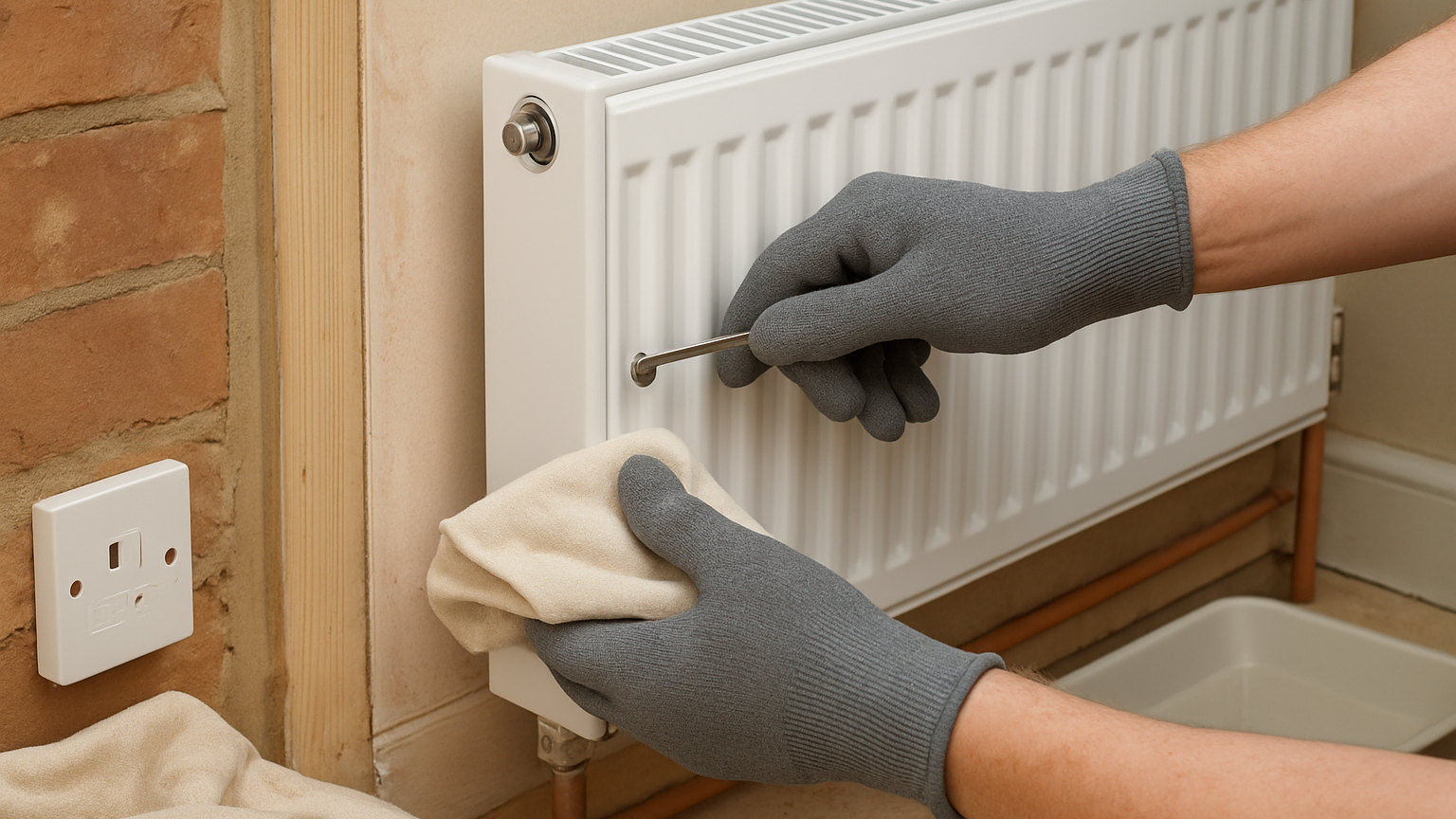
A radiator that is warm at the bottom and cold at the top has air trapped in it. Bleeding takes a couple of minutes per radiator.
What you need
- A radiator bleed key, or a flat screwdriver for some modern valves
- A cloth or a small container to catch the water
- Old towels for the floor
- A second cloth for your hand
Step 1: turn the heating off
Turn the heating off and let the radiators cool.
- The water in a hot system is under pressure and will spray out
- Hot water causes scalds
- A running pump keeps circulating air, so bleeding while it runs is less effective
- Allow an hour or two for the system to cool
Step 2: identify which need doing
- Turn the heating on and let it run for 15 minutes
- Feel each radiator from bottom to top
- Cold at the top, warm at the bottom: trapped air. Bleed it
- Cold at the bottom, warm at the top: sludge, not air. Bleeding will not help
- Cold all over: a valve issue or a circulation problem
- Note which need bleeding, then turn the heating off and let it cool
Step 3: the order
Work systematically so air is not simply pushed around.
- Start downstairs and work up
- Within each floor, start with the radiator furthest from the boiler
- Finish with the one nearest the boiler on the top floor
Step 4: bleed it
- Find the bleed valve, a small square or slotted fitting at the top of one end of the radiator
- Hold a cloth or container underneath it
- Fit the key and turn anticlockwise, no more than a quarter to half a turn
- You will hear air hissing out
- Keep the cloth in place
- As soon as water flows in a steady stream rather than spitting, close the valve
- Turn clockwise until snug. Do not overtighten, which damages the seat
- Wipe up and move to the next radiator
Do not open the valve fully or remove it. It can come out entirely and you will not get it back in against the water.
Step 5: check the boiler pressure
The step people miss.
Bleeding removes water as well as air, so on a sealed system the pressure drops.
- Look at the pressure gauge on the boiler
- Cold system pressure should typically be 1 to 1.5 bar, and the boiler may have a marked green band
- Where it has dropped below about 1 bar, repressurise using the filling loop
- Check the manufacturer's stated figure, since boilers vary
Step 6: repressurise if needed
On a sealed system with a combi or system boiler.
- Find the filling loop: a braided flexible hose with a valve at each end, under the boiler, or an internal keyed filling device
- Make sure both ends are properly connected
- Open one valve, then the other, slowly
- Watch the gauge and close the valves as soon as it reaches the correct pressure
- Close both valves fully
- Disconnect the loop if it is the detachable type, since leaving it connected is not permitted on most systems
Do not overfill. Too high a pressure causes the safety valve to discharge outside. Where it goes above about 2.5 bar cold, some water needs releasing from a bleed valve.
On an older open-vented system with a tank in the loft, there is no pressure gauge and no filling loop; the tank tops the system up automatically.
Step 7: check the result
- Turn the heating back on
- Let it run for 20 minutes
- Feel each radiator again, top and bottom
- Repeat the bleeding on any that are still cold at the top
- Recheck the pressure once it has run and cooled
Why air keeps getting in
Occasional air is normal. Repeatedly needing to bleed is a symptom.
- A small leak somewhere drawing air in as the system cools
- A failed or waterlogged expansion vessel
- Corrosion producing hydrogen gas inside the system, which also indicates sludge
- An open-vented system pumping over into the feed and expansion tank
- Fresh water repeatedly introduced, which brings dissolved oxygen with it
Bleeding weekly is not normal and is worth getting investigated.
If it goes wrong
Nothing comes out: the valve is blocked with scale or paint. Try easing it, or the radiator may simply have no air.
Water sprays out hot: the system was not cooled. Turn the heating off and wait.
Valve will not close and water keeps running: turn both radiator valves off to isolate it, and get a plumber.
Pressure dropping repeatedly: a leak or a failed expansion vessel. Have it investigated.
Radiator still cold at the top after bleeding: more air further along, or a circulation problem.
Towel rails and awkward radiators
- A heated towel rail bleeds the same way, at the top of one end
- Some designer radiators have the bleed valve hidden behind a cap
- A rail that is cold in summer may be on the heating circuit only, not the hot water
- Automatic bleed valves exist and can stick; they are worth checking if a radiator is persistently airlocked
How long it takes
Two minutes per radiator once the system is cool, plus an hour or two of cooling first.
Do the whole house in one session, then repressurise once at the end rather than after each radiator.
A summary
- Turn the heating off and let the system cool
- Work downstairs first, furthest radiator from the boiler first
- Open the valve a quarter turn and close it as soon as water runs steadily
- Check the boiler pressure afterwards and repressurise to 1.5 bar if needed
- Needing to bleed repeatedly means a fault worth investigating


