
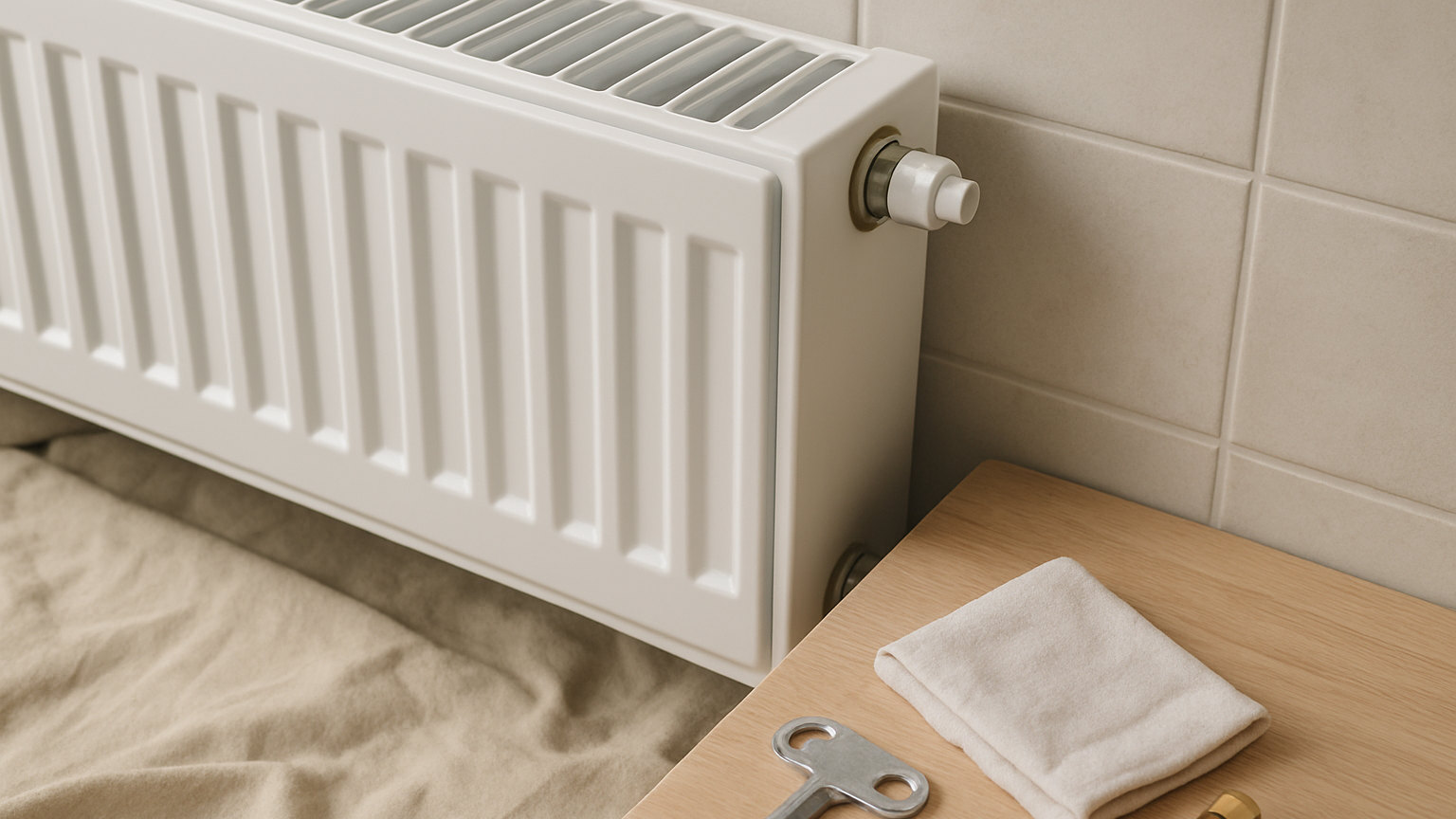
A radiator that will not heat has a small number of causes, and where the cold part is identifies which.
Step 1: diagnose by feel
Run the heating for 20 minutes, then feel the radiator carefully.
- Cold at the top, warm at the bottom: trapped air. Bleed it
- Cold at the bottom, warm at the top: sludge and debris settled in the base
- Cold in the middle at the bottom, warm at both ends: classic sludge build-up
- Cold all over, others warm: a valve problem, usually a stuck pin
- Cold at one end only: restricted flow, or the valve barely open
- All radiators cold: a boiler, pump or system fault, not the radiator
- Only the far radiators cold: the system needs balancing
Fault A: a stuck TRV pin
By far the most common cause of a single cold radiator, and the easiest to fix.
A thermostatic radiator valve has a small pin that the head presses down to close the valve. Over the summer, with the head left open, the pin can seize in the closed position.
- Unscrew the plastic head from the valve body: usually a knurled ring, undone by hand or with light grips
- Lift the head off, revealing a small metal pin, typically 5 to 10mm, in the top of the valve body
- Press the pin down with a finger or thumb. It should spring back freely
- If it does not move, it is stuck
- Free it by gripping the pin with pliers and gently working it up and down, pulling upward rather than hammering it
- Apply a little penetrating oil around the pin and work it repeatedly
- Once it springs freely, refit the head and turn it to maximum
- Run the heating and check
Do not force the pin sideways or strike it, which damages the valve.
To prevent it: leave TRVs on maximum over the summer, or turn every TRV fully open and closed a few times at the start of autumn.
Fault B: valves closed
- Check the TRV or wheel valve at one end is open. Turn it fully anticlockwise
- Check the lockshield valve at the other end, usually under a plastic cap
- Remove the cap and check the valve is open, turning anticlockwise with a spanner or grips
- Count the turns as you open it, so you can restore the balance later
Fault C: the system needs balancing
Where radiators near the boiler are hot and distant ones are cool, water is taking the easy route.
- Open every radiator valve fully, both ends, and run the heating until all are as hot as they will get
- Starting with the radiator nearest the boiler, close its lockshield fully, then open it about a quarter turn
- Work outward, opening each successive lockshield slightly more
- Leave the furthest radiator's lockshield fully open
- Run the system and check the temperature difference across each radiator
- Aim for roughly 11 to 12 degrees difference between the flow and return pipes of each radiator, measured with a thermometer or by feel
- Adjust and repeat over a few days
Balancing is fiddly and it is the correct fix for a system where the far end never warms up.
Fault D: sludge
Cold at the bottom, particularly in the middle, means magnetite sludge has settled.
Sludge is iron oxide from internal corrosion. It settles in the base of radiators and blocks the flow.
Option 1: remove and flush the radiator.
- Close both valves, counting and noting the lockshield turns
- Put down plenty of towels and a large container
- Undo the union nut at one end slowly and drain the radiator into the container
- Undo the other end and lift the radiator off its brackets, keeping it level
- Take it outside and flush it through with a hose from both ends until the water runs clear
- Rehang, reconnect, open the valves and restore the lockshield to the same number of turns
- Bleed it and check the boiler pressure
A radiator full of water is very heavy. Get help, and expect black water that stains everything it touches.
Option 2: a power flush or chemical clean of the whole system, which is a job for a heating engineer and the right answer where several radiators are affected.
Prevention
- Have a corrosion inhibitor in the system, topped up after any drain-down
- Fit a magnetic filter on the return to the boiler, and have it cleaned annually
- Have the system serviced annually
- Exercise TRVs at the end of summer
When to call an engineer
- All radiators cold: a boiler or pump fault
- Repeated pressure loss
- Several radiators sludged, needing a system flush
- Anything involving the boiler itself
- Any smell of gas: leave, do not touch switches, and call the emergency line
If it goes wrong
Pin freed but still cold: the TRV head may have failed. Heads are replaceable without draining the system.
Radiator hot but the room is cold: the radiator may be undersized, or blocked by furniture or a long curtain.
Leaking after refitting: the union needs remaking, not just tightening.
Cold again next season: sludge returning. The system needs inhibitor and possibly a flush.
Pressure dropped after the work: normal after draining a radiator. Repressurise via the filling loop.
Counting the lockshield
Worth spelling out, since it is easy to lose.
- Before closing the lockshield, turn it fully closed while counting the turns and part turns
- Write the number down, not just remember it
- On refitting, open it by exactly that number of turns
- The system balance is then unchanged
Reopening a lockshield fully instead unbalances the system and makes other radiators cool.


