
Different pipe noises have different causes, and identifying the noise correctly points straight at the fix.
Identify the noise
A loud bang or thud when a tap or appliance shuts off: water hammer.
Ticking or creaking as the heating warms or cools: pipes expanding and contracting against joists or clips.
A continuous hum or whistle while water runs: high pressure, a partly closed valve, or a worn washer vibrating.
A vibrating rattle when a tap runs: a loose pipe, or a failing valve.
Gurgling from a drain when another fitting is used: a waste or vent problem rather than a supply one.
Water hammer: what it is
Water moving along a pipe has momentum. When a valve closes suddenly, that moving column of water stops abruptly and the energy has to go somewhere: it produces a pressure surge that shakes the pipe.
Common triggers:
- Washing machines and dishwashers, which use fast-acting solenoid valves
- Quarter-turn lever taps
- Toilet fill valves shutting off
- Mains pressure showers
Repeated hammering stresses joints and can eventually cause leaks, so it is worth curing rather than living with.
What you need
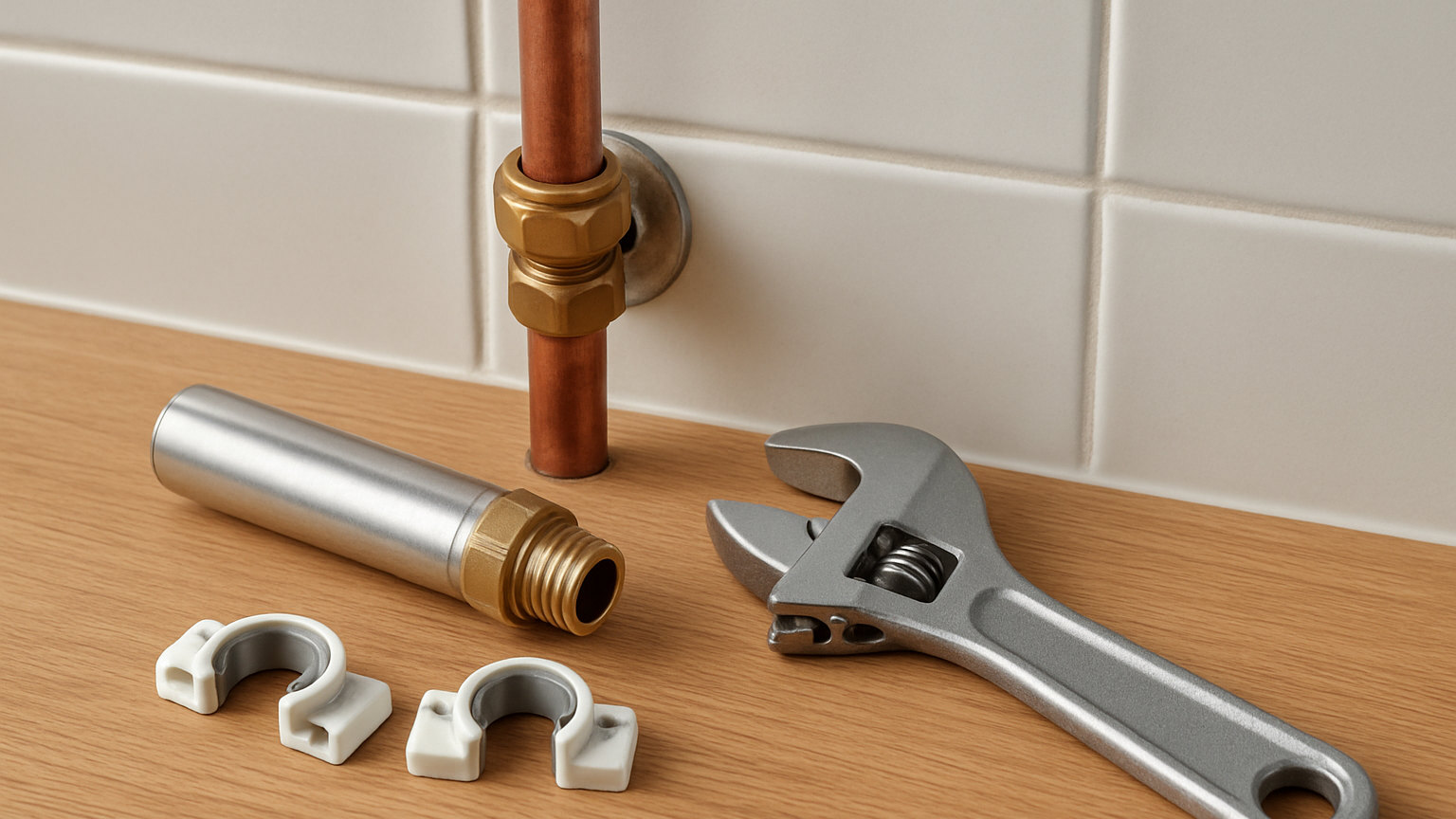
- Pipe clips of the correct size, and screws
- Foam pipe insulation or felt, for cushioning
- A shock arrestor, if needed
- A pressure gauge that fits a tap, and a pressure reducing valve if needed
- A screwdriver and a drill
Fix 1: clip the pipes
The most common cure and the cheapest.
- Have someone operate the tap or appliance that triggers it while you locate the noise
- Look under floorboards, in the airing cupboard, under sinks and in the loft
- Feel the pipe as the valve closes: the vibrating section is the one to secure
- Fit pipe clips at regular intervals, roughly every 1.2m on horizontal runs and 1.8m on vertical, and closer near bends and valves
- Screw the clips into a joist or a solid fixing, not into plasterboard alone
- Where a pipe passes through a joist or a hole, pack around it with foam or felt so it cannot knock
- Do not clamp so tightly that the pipe cannot expand at all
A pipe that is unsupported over a long run will always be noisy.
Fix 2: fit a shock arrestor
A small sealed device containing an air cushion, which absorbs the pressure surge.
- Fitted on the supply close to the offending appliance or tap
- Available as an in-line fitting, or as one that screws onto a washing machine valve
- The screw-on type for a washing machine hose is straightforward to fit and cures most appliance-related hammer
- An in-line arrestor means cutting into the pipework
Fix 3: air locks and old air chambers
Older installations sometimes had a vertical capped pipe near an outlet acting as an air cushion. Over time it fills with water and stops working.
- Turn off the stopcock
- Open every tap in the house, working from the highest to the lowest, and let the system drain
- Close all the taps
- Turn the stopcock back on slowly
- Open the taps one at a time from lowest to highest to purge the air
This recharges any air chambers and can cure the noise for a period.
Fix 4: reduce the pressure
Very high incoming mains pressure makes hammer worse and causes humming.
- Measure it with a pressure gauge that screws onto an outside tap or a washing machine valve
- UK mains pressure is commonly 2 to 5 bar, and can be higher
- Above about 4 bar, a pressure reducing valve fitted on the incoming main is worth considering
- That is a plumber's job, and it also reduces water use and stress on appliances
Ticking and creaking
Not water hammer. This is thermal expansion in heating pipework.
- Copper expands as it heats and rubs against joists, clips and floorboards
- Lift the board over the noisy area and find the contact point
- Enlarge a tight notch in a joist slightly, and line it with felt or foam
- Pack around the pipe where it passes through anything
- Do not clip a heating pipe rigidly at every point; it needs room to move
- Lowering the boiler flow temperature slightly reduces the expansion
Humming and whistling
- A partly closed valve creating turbulence: open it fully
- A worn tap washer vibrating: replace it
- A failing fill valve in a toilet cistern: replace it
- Very high pressure: fit a pressure reducing valve
- A pump running too fast: the speed setting can usually be reduced
If it goes wrong
Hammer continues after clipping: fit a shock arrestor near the appliance causing it.
Noise moved elsewhere: the vibration is travelling. Clip the next section too.
Only when the washing machine fills: a screw-on arrestor at the machine valve.
Ticking in the heating only: thermal expansion. Free the pipe where it is trapped.
Noise from the boiler itself: kettling or a pump fault. Call an engineer.
Tracing the noise
- Have someone operate the tap or appliance repeatedly
- Listen at each floor and in the airing cupboard
- Put a hand flat on the pipe at accessible points to feel the vibration
- Lift a floorboard over the suspected run, checking for cables and pipes before cutting anything
- Mark the noisy section before replacing the board
The noise is frequently some distance from where it is heard, since sound travels along pipework and joists.
A summary
- Identify the noise: a bang is hammer, ticking is expansion, humming is pressure or a worn valve
- Clip loose pipes and pack where they pass through joists
- Fit a shock arrestor near the appliance causing it
- Check the mains pressure, and fit a reducing valve above about 4 bar
- Leave heating pipes room to expand rather than clamping them rigid


