
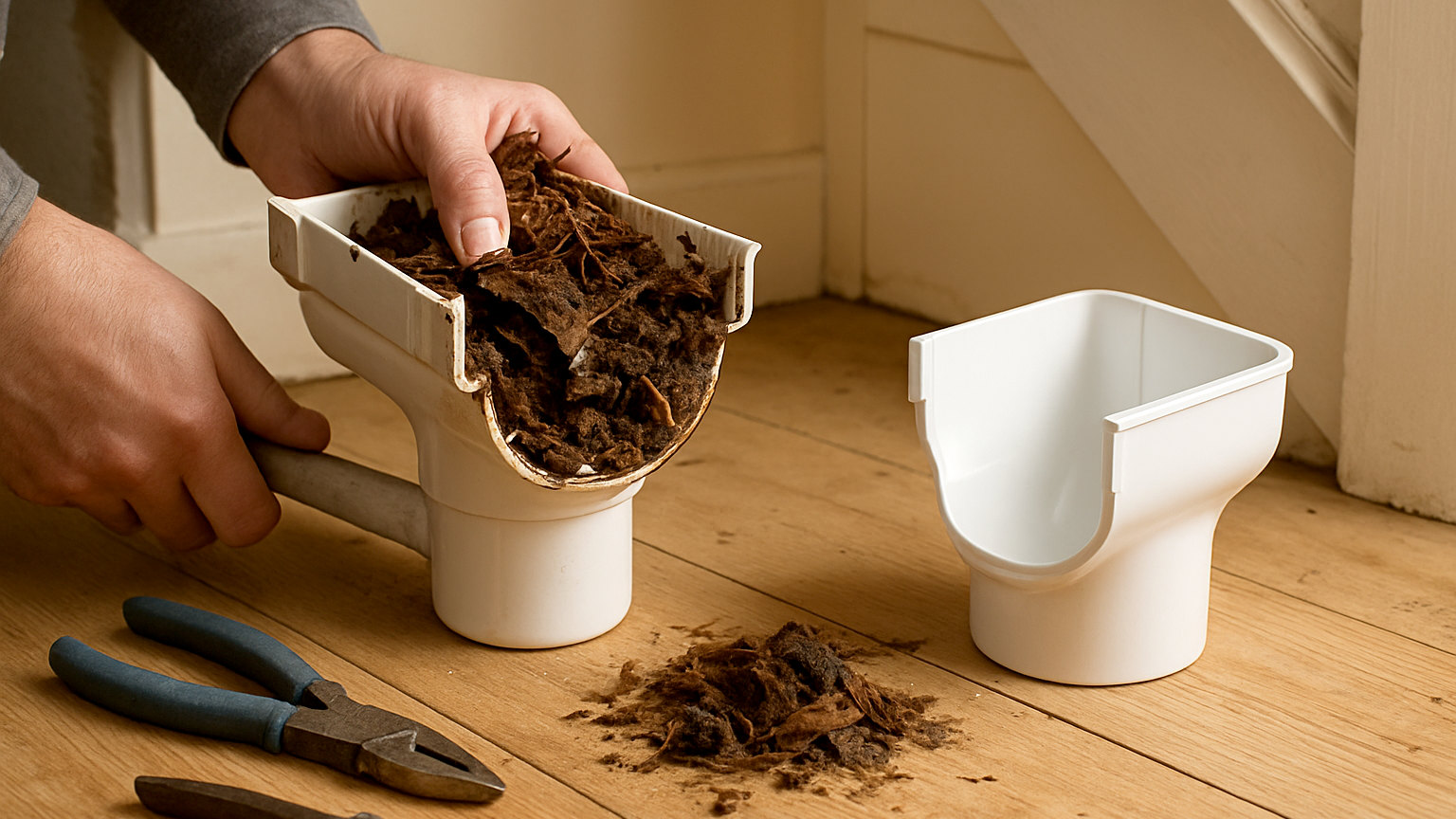
Overflowing gutters cause a large proportion of penetrating damp. Clearing them twice a year is one of the highest-value maintenance jobs on a house.
Safety first
- Never rest a ladder on the gutter. It will bend, break, or slip. Use a ladder standoff, which bears on the wall instead
- Set the ladder at 4 to 1: one out for every four up
- Firm, level ground, and tied or footed
- Do not overreach. Move the ladder every metre or so
- Do not lean out to reach the next section
- Do not do it alone if you can avoid it
- Not in wind, rain or frost
- Above single storey, consider a tower or a contractor
Working from the ground with a telescopic tool is safer and frequently just as effective.
What you need
- A ladder with a standoff, or a tower
- A gutter scoop, a trowel, or a plastic scraper
- A bucket with a hook, or heavy-duty bags
- A hosepipe
- Drain rods or flexible rods for downpipes
- Stout gloves and eye protection
- Dust sheets or a tarpaulin below
Step 1: when to do it
- Autumn, after the leaves have fallen, which is the main clean
- Spring, to clear winter debris, moss and any nesting material
- More often where there are overhanging trees
- After any storm
- Before winter, so ice does not build in a blocked gutter
Step 2: clear the debris
- Hang a bucket from the ladder, or a bag
- Start at the end furthest from the downpipe and work towards it
- Scoop the debris out by hand or with a scoop, into the bucket
- Do not push debris towards the downpipe, which blocks it
- Clear the gutter down to the bare surface
- Move the ladder rather than reaching
- Check and clear the outlet at the downpipe
Wear gloves: gutters contain sharp fragments, bird droppings and rotting material.
Step 3: flush it through
- Run a hose into the gutter at the far end
- Watch the water run along and down the outlet
- Check for standing water, which shows the fall is wrong or the gutter is sagging
- Check every joint and bracket for drips while the water runs
- Check the water leaves the downpipe freely at the bottom
- Note any leak positions for repair
Step 4: check the fall
A gutter should fall gently towards the outlet.
- A commonly used guide is around 1 in 350 to 1 in 600, roughly 3mm per metre
- Standing water after flushing indicates a problem
- A sagging section usually means a failed or missing bracket
- Brackets should be at around 800mm to 1m centres, and closer at joints
- Add a bracket where a section sags
Step 5: clear the downpipe
If water backs up at the outlet, the downpipe is blocked.
- Run the hose down from the top and see whether it flows
- Where it does not, feed flexible rods or a drain auger down from the top
- Or rod up from the bottom, which is easier and safer from the ground
- On a pipe with a swan neck at the top, the bend is the usual blockage point
- Some downpipes have an access hatch; open it and clear from there
- Where nothing works, the pipe may need dismantling section by section
- Flush thoroughly afterwards
Step 6: check the bottom
- The downpipe should discharge into a gully or a back inlet, not onto the ground
- Clear leaves and silt from the gully by hand, with gloves
- Check the gully grating is present and clear
- Check the shoe at the bottom of the pipe directs water into the gully
- A downpipe discharging against the wall soaks it every time it rains
Ground-based tools
Worth considering, and much safer.
- Telescopic gutter cleaning attachments for a pressure washer or a hose
- Gutter vacuum systems with a camera on the end, which show what you are doing on a screen
- Telescopic scoops and brushes
- A phone on a pole to inspect afterwards
These will not do as thorough a job as hand clearing, and they avoid the ladder entirely.
Gutter guards
Mixed value, and worth understanding.
- Brush inserts: cheap, easy to fit. They catch leaves on top, and still need clearing
- Mesh and hedgehog guards: keep large debris out, and can clog with fine material
- Solid covers: more effective and more expensive, and they still need periodic attention
- None of them removes the need to inspect
- Leaf guards at the downpipe outlet, a simple wire balloon, are cheap and prevent most downpipe blockages
Why it matters
An overflowing gutter:
- Saturates the wall below, causing penetrating damp inside
- Rots the fascia and the roof timbers behind
- Soaks the ground at the base of the wall, which can bridge the damp proof course
- Freezes in winter, and the weight can pull the gutter off
- Damages the pointing and the render
If it goes wrong
Water standing in the gutter after clearing: the fall is wrong or a bracket has failed.
Downpipe will not clear: dismantle it section by section, or get a contractor.
Gutter leaking at a joint: the seal has failed. It needs the joint remaking.
Blocks again within weeks: overhanging trees. Consider guards or more frequent clearing.
Cannot reach safely: use a ground-based tool or get someone in.
A summary
- Never rest a ladder on a gutter; use a standoff
- Clear twice a year, in autumn and spring
- Work from the far end towards the downpipe
- Flush with a hose and check for standing water and drips
- Clear the downpipe and the gully at the bottom
- Consider ground-based tools rather than a ladder


