
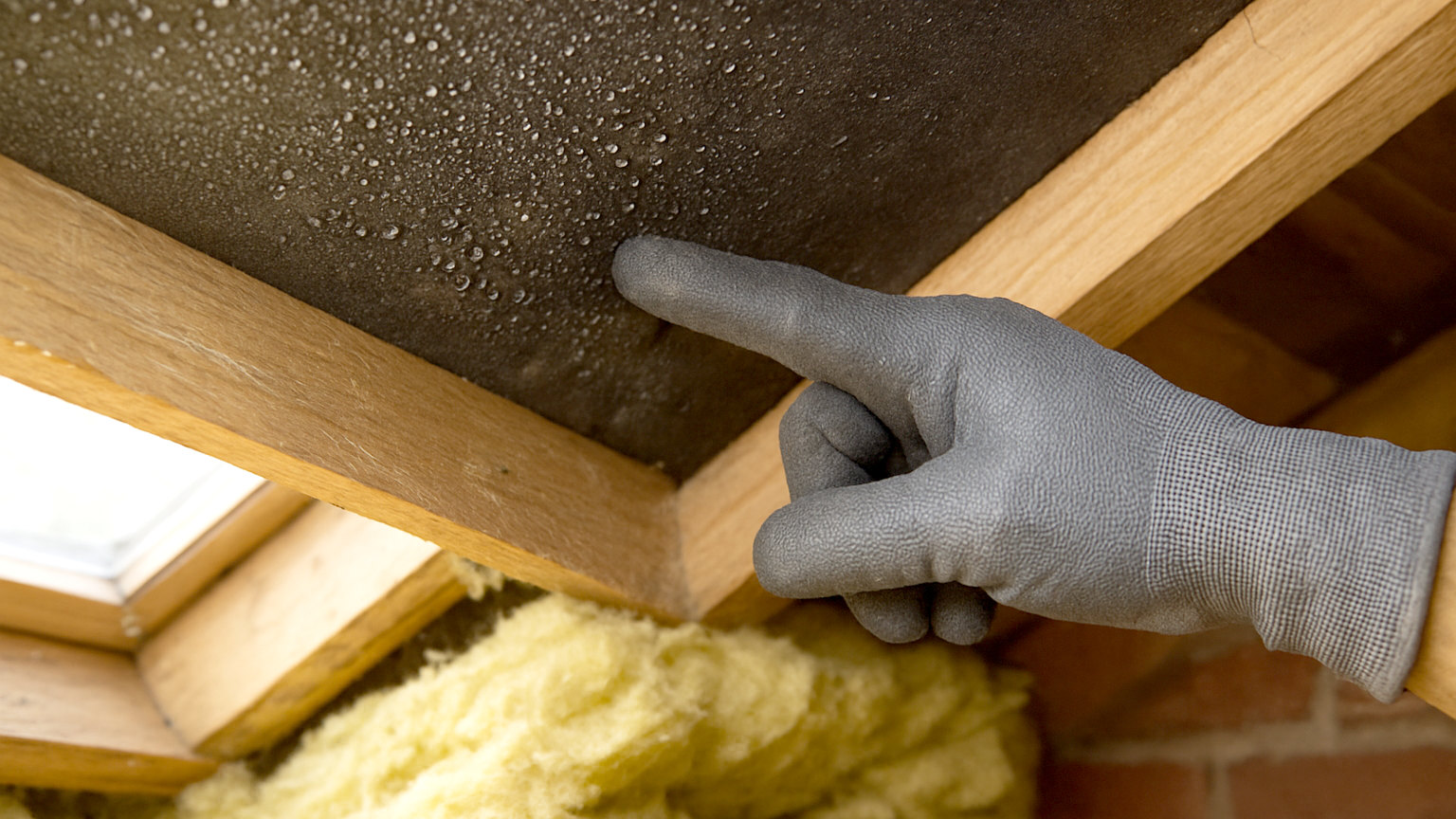
Damp in a loft is frequently assumed to be a leak. Where it is widespread rather than a defined drip, it is condensation, and the fix is completely different.
Step 1: tell it from a leak
Condensation:
- Widespread dampness across the underside of the felt or membrane
- Droplets over a large area, sometimes described as looking like it has rained inside
- Damp on the underside of the roof covering rather than running down from a point
- Worse in cold weather, better in summer
- Unrelated to rainfall
- Frequently worse near the middle of the roof and away from ventilation
- Black mould on the timbers and the underside of the felt
- Damp insulation over a wide area
A leak:
- A defined drip from one point
- A staining trail running down a rafter
- Appears during and after rain
- Traceable upward to a specific entry point
- Daylight may be visible
Check it during and after heavy rain, and again on a cold dry morning. That distinguishes them.
Step 2: where the moisture comes from
Warm moist air from the house rises into the loft and condenses on the cold roof.
Common routes:
- An uninsulated, unsealed loft hatch
- Gaps around pipes, cables and light fittings passing through the ceiling
- Recessed downlights, which are effectively holes in the ceiling
- An extractor fan or a tumble dryer discharging into the loft instead of outside
- Gaps at the top of partition walls
- A loft hatch left open
- Drying washing in the house without ventilation
- An unvented or poorly sealed cold water tank
Step 3: check the ventilation
- Look along the eaves inside the loft. Can you see daylight, or feel air movement?
- Check insulation has not been pushed into the eaves, blocking the airway
- Go outside and check the soffit vents are present and not painted over, blocked or full of debris
- Check for ridge or tile vents
- Check gable vents where present
- Note whether a new roofing membrane has been fitted, and whether ventilation was adjusted at the same time
Blocked eaves are the commonest single cause of loft condensation, and frequently the result of topping up insulation.
Step 4: fix the moisture routes
Stop moist air getting into the loft in the first place.
- Insulate and draught-seal the loft hatch: rigid insulation board on top, compression seal around the frame
- Check every extractor fan ducts to outside, through the roof or the soffit, not simply into the loft. This is a very common fault
- Check the duct is still connected, since they work loose
- Insulate any ducting passing through the loft, or moist air condenses inside it and drips back
- Check a tumble dryer vents outside
- Seal gaps around pipes and cables passing through the ceiling
- Fit covers or hoods over downlights, using fire-rated products
- Fit a lid to a cold water tank
Step 5: improve the ventilation
- Fit eaves ventilation trays so insulation cannot block the airway
- Clear any blocked soffit vents
- Add soffit vents where there are none
- Consider tile vents or a dry ridge system for high-level ventilation, which works with the eaves to create airflow
- Gable vents where the roof design allows
Air needs to enter low and leave high. Eaves ventilation alone, with no high-level outlet, is less effective.
Step 6: reduce moisture in the house
The same measures as any condensation problem.
- Dry washing outside, or in one room with the door shut and extraction running
- Run extractor fans during and for 15 minutes after cooking and showering
- Open trickle vents and leave them open
- Keep steady low background heat
- Aim for 40 to 60 per cent relative humidity, measured with a hygrometer
Step 7: deal with the mould
- Treat affected timbers with a fungicidal wash, following the contact time
- Wear an FFP2 or FFP3 respirator, gloves and eye protection, and ventilate
- Do not dry brush it, which throws spores into the air
- Replace insulation that has been soaked, since wet mineral wool does not recover its performance
- Let the timbers dry fully
- Check the timbers for rot by probing with a screwdriver
Modern membranes
- Older bitumen felt is not breathable, so the loft relies entirely on ventilation
- A modern breathable membrane allows water vapour through, which reduces the ventilation requirement
- A breathable membrane still needs the eaves detail correct
- Condensation on the underside of a breathable membrane suggests either a lot of moisture from below or a detailing problem
Room in roof and warm roofs
Where a loft has been converted, the roof is usually a warm roof: insulation follows the roof slope rather than the ceiling.
- These have a different ventilation requirement, frequently a ventilated void above the insulation
- Insulation stuffed tight against the underside of the roof with no gap causes condensation within the structure
- Get advice rather than assuming
If it goes wrong
Condensation persists after ventilating: a large moisture source from below. Check every fan actually vents outside.
Worse after insulating: the eaves are blocked. Fit ventilation trays.
Mould returns: the moisture source has not been dealt with.
Insulation wet through: replace it; it will not recover.
Timbers soft when probed: rot. Get it assessed by a builder or a surveyor.
A summary
- Widespread damp on the felt is condensation; a defined drip is a leak
- Check it during rain and again on a cold dry morning
- Blocked eaves are the commonest cause, usually after topping up insulation
- Check every extractor fan actually ducts outside, not into the loft
- Insulate ducting passing through the loft
- Air must enter low at the eaves and leave high at the ridge


