
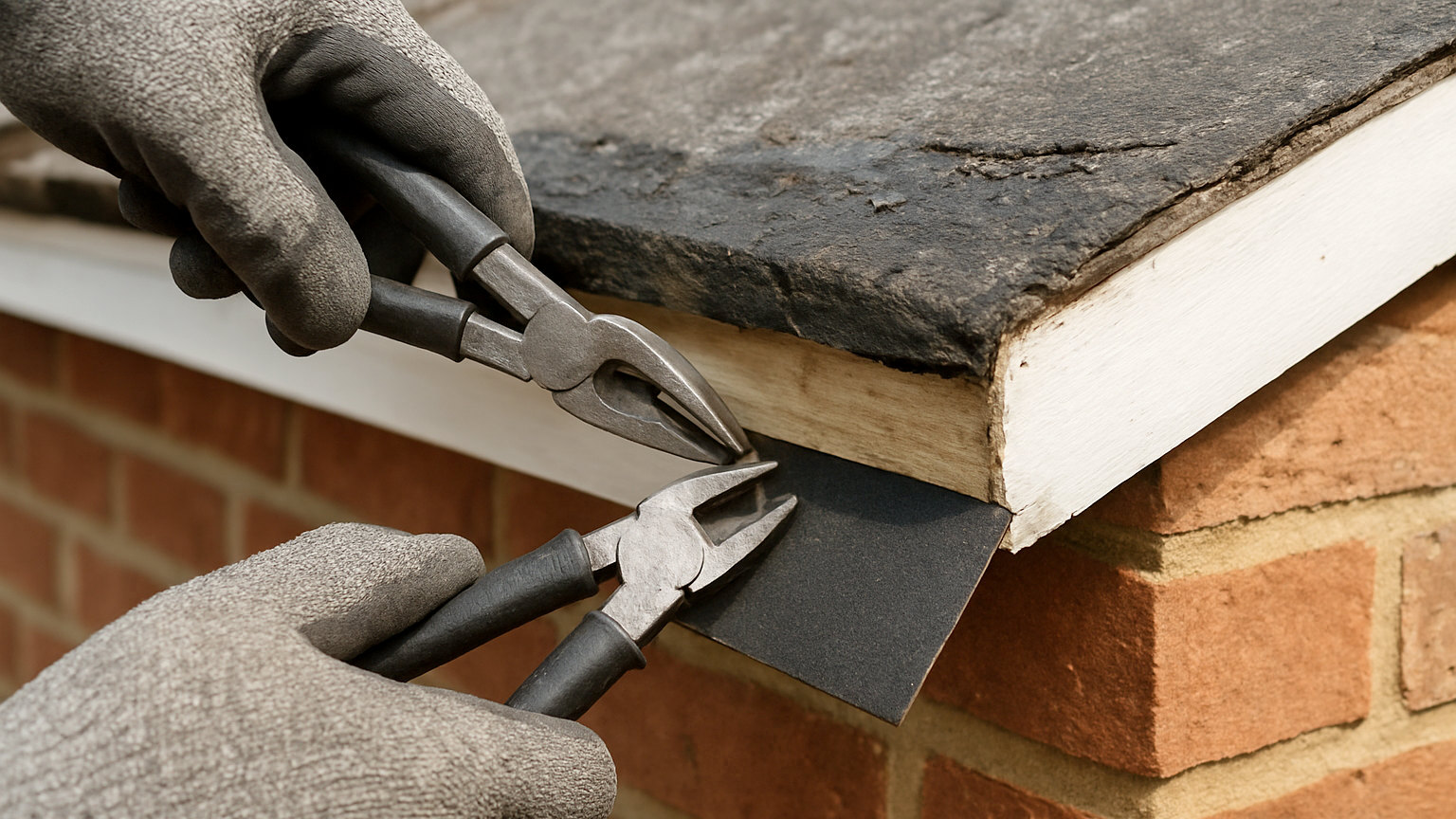
Flat roofs on extensions, garages, dormers and porches have a finite life and a small number of characteristic failures.
Safety
Do not walk on a flat roof unless you know it will take your weight.
- A garage roof over lightweight joists, an old felt roof, or anything with a rooflight is a fall risk
- Deck boards may be rotten beneath an intact covering
- Look for soft spots, springiness or visible sagging
- Never walk on a wet, frosty or mossy flat roof
- Work from a tower or a properly set ladder where you can
- Never step onto a fragile surface such as a plastic rooflight
The coverings
Built-up felt. Layers of bitumen felt, torched or bonded. The traditional covering. Lifespan very variable: a cheap two-layer system may last 10 years, a good three-layer high-performance system 20 to 25.
EPDM rubber. A single rubber membrane, frequently in one piece with no joints on a domestic roof. Flexible, UV stable, commonly quoted at 20 to 30 years or more.
GRP fibreglass. A glass fibre laminate cured in place, giving a seamless rigid finish. Around 20 to 25 years. Rigid, so it can crack if the deck moves.
Single ply membrane. PVC or TPO sheet, welded at the seams. Commercial in origin, increasingly used domestically.
Asphalt. Traditional mastic asphalt, long lasting and now uncommon domestically.
Lead. Very long lasting, used on small areas, dormers and bays. Specialist work.
Step 1: inspect it
Do this in spring and autumn, and after any storm.
- Look for splits, cracks and tears, particularly at corners and joints
- Look for blisters and bubbles, where water or air is trapped beneath
- Check the upstands, where the roof meets a wall. This is the commonest leak point
- Check the flashing or the cover flashing above the upstand
- Check around any rooflight, vent pipe or aerial fixing
- Check the drip edge and the gutter detail at the outer edge
- Look for ponding: standing water more than 48 hours after rain
- Look for moss, algae and debris, which hold water
- Check for soft or springy areas underfoot, which mean a rotten deck
Step 2: understand ponding
Standing water on a flat roof.
- A flat roof is not flat: it should have a fall of at least 1 in 80 as designed, and 1 in 40 is frequently specified to allow for deflection
- Ponding accelerates deterioration, encourages growth, adds weight and finds any weakness
- Causes: insufficient original fall, deck deflection, sagging joists, or a blocked outlet
- Correcting ponding usually means relaying the deck with new falls, or using tapered insulation. It is not solved by patching
Step 3: find the leak
Harder than on a pitched roof, because water travels between the covering and the deck.
- Note where the water appears inside, and remember the entry point is frequently well away from it
- Inspect the upstands first, then the outlets, then the general field
- Check around every penetration: pipes, vents, fixings
- Look for the low point, since water finds it
- Where accessible from below, look at the underside of the deck for staining
- A hose test, working in sections from the low point upward, can locate it
Step 4: what can be patched
Reasonable to patch:
- A small isolated split or puncture in an otherwise sound covering
- A lifted seam
- A single blister
- A localised upstand failure
Not worth patching:
- Widespread crazing, cracking or brittleness
- Multiple blisters across the roof
- A soft or springy deck, which means rot beneath
- A covering at or beyond its design life
- Persistent ponding
- Repeated leaks in different places
Patching a covering that has reached the end of its life is money spent twice.
Step 5: patching felt
For a small split, in dry weather.
- Clean the area thoroughly and let it dry completely
- Cut back any loose material
- Where there is a blister, cut a cross through it, fold the flaps back, dry it out, then bond the flaps down
- Apply a bituminous primer if the product requires it
- Cut a self-adhesive repair patch overlapping the damage by at least 100mm all round, with rounded corners
- Bond it down firmly, working from the centre outward to exclude air
- Seal the edges with a compatible sealant
Repairs must be compatible with the existing covering. Solvent-based products can damage EPDM; bitumen products do not bond to GRP.
Step 6: repairs to other coverings
- EPDM: repaired with EPDM patches and the manufacturer's primer and adhesive. Clean and dry surfaces are essential
- GRP: repaired by abrading and laminating new matting and resin. Needs dry conditions and care with the resin
- Single ply: hot air welded, which is specialist
- Lead: welded or patched by a leadworker. Not a DIY repair
In each case, use the manufacturer's own repair system.
Step 7: when to replace
Replacement is a job for a roofer, and worth understanding.
- The covering is stripped and the deck inspected and repaired
- Falls are corrected, with tapered insulation or firrings
- Insulation is upgraded, which is normally required by Building Regulations when a flat roof is substantially replaced
- New covering laid with proper upstands, drip edges and outlets
- Replacing more than a set proportion of a roof covering is notifiable under Building Regulations, and thermal upgrading is usually required. Check before starting
- Get a written guarantee and keep it
Maintenance
- Clear leaves and debris twice a year
- Keep outlets and gutters clear
- Remove moss and algae carefully, without damaging the covering
- Cut back overhanging branches
- Inspect the upstands annually
- Do not use the roof for storage
- Do not fix anything through the covering
If it goes wrong
Leak persists after patching: there is more than one point of entry, or the covering has failed generally.
Blister returns: moisture is trapped in the build-up.
Roof feels soft underfoot: the deck has rotted. Stop walking on it and get it assessed.
Ponding after repair: a fall problem, which patching cannot fix.
Repair will not bond: incompatible product, or a damp surface.
A summary
- Do not walk on a flat roof unless you know it will take your weight
- Check the upstands first; they are the commonest leak point
- Ponding means a fall problem, which patching will not fix
- Use the manufacturer's own repair system for the covering you have
- Patching a covering at the end of its life is money spent twice
- Substantial replacement is notifiable and usually requires thermal upgrading


